

Call us
301-363-4651 (Available 9 a.m. to 5 p.m. CST from Monday to Friday)

| Code | CSB-RA185642A0HU |
| Size | US$210 |
| Order now | |
| Image |
|
| Have Questions? | Leave a Message or Start an on-line Chat |
| Application | Recommended Dilution |
|---|---|
| WB | 1:500-1:2000 |
| IHC | 1:50-1:200 |
DNA polymerase beta plays an essential role in base excision repair, the primary pathway cells use to correct small DNA lesions caused by oxidation, alkylation, and spontaneous base loss. This enzyme's dual activities—nucleotidyl transferase and deoxyribose phosphate lyase—make it indispensable for maintaining genomic integrity, positioning it as a key target in cancer biology, aging research, and studies of DNA damage response mechanisms.
This recombinant monoclonal antibody, generated from clone 6F4, offers the consistency and reproducibility that demanding experimental workflows require. Because recombinant antibodies are produced from defined sequences rather than traditional hybridoma methods, researchers benefit from lot-to-lot uniformity that supports longitudinal studies and ensures comparable results across experiments. The rabbit host and IgG isotype provide strong signal amplification while the affinity-chromatography purification delivers a clean reagent suitable for sensitive detection methods.
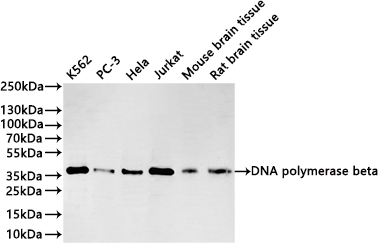
Validation studies demonstrate robust performance across multiple applications and species. Western blot analysis confirms specific detection of the 38 kDa POLB protein—matching the predicted molecular weight—in human cell lines including K562, PC-3, HeLa, and Jurkat, as well as mouse and rat brain tissue lysates, establishing reliable cross-species reactivity for comparative studies. Immunohistochemistry validation in paraffin-embedded human testis tissue shows clear staining using standard antigen retrieval protocols, expanding utility to tissue-based investigations of POLB expression patterns.
With validated performance in ELISA, Western blot, and immunohistochemistry, this antibody supports diverse experimental approaches from quantitative protein detection to spatial localization studies. Researchers investigating DNA repair deficiencies, chemotherapy resistance mechanisms, or the molecular basis of mutagenesis will find this reagent well-suited to their analytical needs.
There are currently no reviews for this product.





