
Call us
301-363-4651 (Available 9 a.m. to 5 p.m. CST from Monday to Friday)

| Code | CSB-RA007795A724phHU |
| Size | US$210 |
| Order now | |
| Image |
|
| Have Questions? | Leave a Message or Start an on-line Chat |
| Application | Recommended Dilution |
|---|---|
| WB | 1:500-1:5000 |
| IF | 1:20-1:200 |
ERN1, also known as IRE1α, serves as a critical sensor of endoplasmic reticulum stress and plays a central role in the unfolded protein response. This dual-function kinase and endoribonuclease becomes activated through autophosphorylation at Serine 724, making this specific phosphorylation site an essential marker for monitoring ER stress pathway activation. Researchers investigating cellular stress responses, metabolic disorders, and disease states where ER homeostasis is disrupted will find phospho-S724 detection particularly valuable for understanding IRE1α signaling dynamics.
This recombinant monoclonal antibody, generated from clone 1F12 in rabbit, offers the reproducibility and consistency that demanding experimental workflows require. Because recombinant antibodies are produced from defined sequences rather than traditional hybridoma methods, you can expect reliable performance across experiments and between lots, eliminating a common source of variability in phospho-specific detection studies.
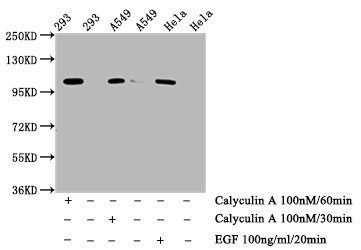
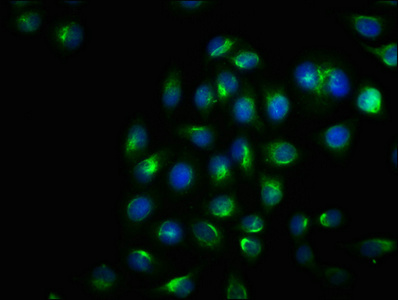
Validation testing demonstrates robust performance across multiple platforms. Western blot analysis confirms specific detection of phosphorylated ERN1 at the expected 110 kDa molecular weight in human cell lines including 293, A549, and HeLa cells. The antibody performs effectively across a broad working range of 1:500 to 1:5000, giving you flexibility to optimize signal-to-background ratios for your specific samples. Immunofluorescence studies in HeLa cells reveal clear subcellular localization patterns, enabling visualization of activated IRE1α within the ER compartment at dilutions between 1:20 and 1:200.
Whether you are characterizing ER stress responses in cancer biology, investigating metabolic signaling, or exploring therapeutic targets within the unfolded protein response pathway, this phospho-specific antibody provides a reliable tool for signal transduction research requiring precise detection of IRE1α activation status.
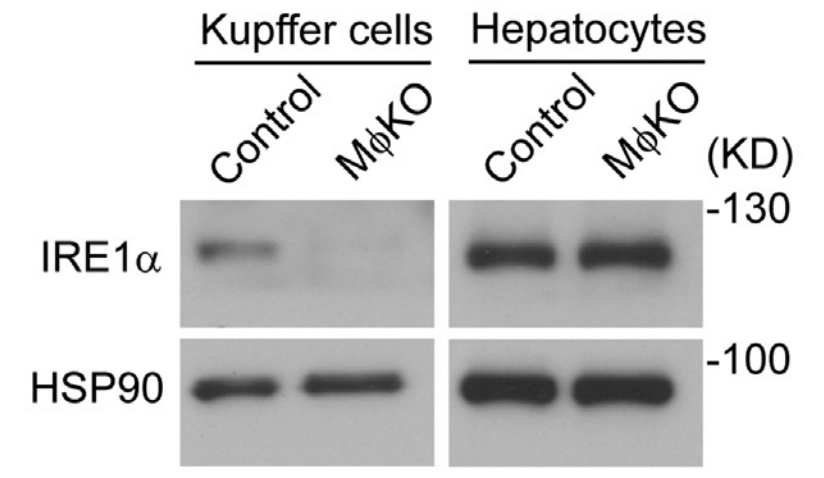
Applications : Immunoblot analysis
Sample type: cell
Review: Immunoblot analysis of IRE1α in lysates of Kupffer cells and hepatocytes freshly isolated from livers of male MΦKO mice or Ern1-flox/flox control littermates. HSP90 was used as the loading control. B–E, MΦKO or floxed control mice were subjected to sham or hepatic warm ischemia/reperfusion (n=3–4 per group).
By Anonymous





