Phospho-GYS1 (S641) Recombinant Monoclonal Antibody

Code CSB-RA010078A641phHU
Size US$210
Order now
Image
  • Western Blot
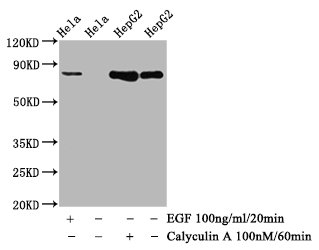
    Positive WB detected in Hela whole cell lysate,HepG2 whole cell lysate(treated with Calyculin A or EGF)
    All lanes Phospho-GYS1 antibody at 1.12μg/ml
    Secondary
    Goat polyclonal to rabbit IgG at 1/50000 dilution
    Predicted band size: 85 KDa
    Observed band size: 85 KDa
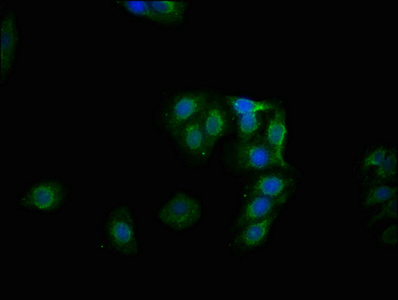
  • Immunofluorescence staining of HepG2 cells with CSB-RA010078A641phHU at 1:100,counter-stained with DAPI. The cells were fixed in 4% formaldehyde, permeabilized using 0.2% Triton X-100 and blocked in 10% normal Goat Serum. The cells were then incubated with the antibody overnight at 4℃. The secondary antibody was Alexa Fluor 488-congugated AffiniPure Goat Anti-Rabbit IgG (H+L).
Have Questions? Leave a Message or Start an on-line Chat

Product Details

Uniprot No.
Target Names
Alternative Names
Glycogen [starch] synthase antibody; Glycogen synthase 1 (muscle) antibody; Glycogen synthase 1 antibody; GSY antibody; GYS antibody; Gys1 antibody; GYS1_HUMAN antibody; muscle antibody
Species Reactivity
Human
Immunogen
A synthesized peptide derived from Human Phospho-GYS1 (S641)
Immunogen Species
Homo sapiens (Human)
Conjugate
Non-conjugated
Clonality
Monoclonal
Isotype
Rabbit IgG
Clone No.
1D1
Purification Method
Affinity-chromatography
Concentration
It differs from different batches. Please contact us to confirm it.
Buffer
Rabbit IgG in 10mM phosphate buffered saline , pH 7.4, 150mM sodium chloride, 0.05% BSA, 0.02% sodium azide and 50% glycerol.
Form
Liquid
Tested Applications
ELISA, WB, IF
Recommended Dilution
Application Recommended Dilution
WB 1:500-1:5000
IF 1:20-1:200
Troubleshooting and FAQs
Storage
Upon receipt, store at -20°C or -80°C. Avoid repeated freeze.
Lead Time
Basically, we can dispatch the products out in 1-3 working days after receiving your orders. Delivery time maybe differs from different purchasing way or location, please kindly consult your local distributors for specific delivery time.
Description

Glycogen synthase 1 (GYS1) serves as the rate-limiting enzyme in muscle glycogen synthesis, making it a central regulatory node in cellular energy metabolism. Phosphorylation at serine 641 represents one of the key inhibitory modifications that controls GYS1 activity, with this site serving as a direct target of glycogen synthase kinase-3 (GSK-3) and a readout of upstream insulin and growth factor signaling cascades. Researchers investigating metabolic regulation, diabetes pathways, or energy homeostasis rely on precise detection of this phosphorylation event to understand how cells balance glycogen storage with glucose utilization.

This recombinant rabbit monoclonal antibody, clone 1D1, was developed against a synthetic phosphopeptide corresponding to the human GYS1 sequence surrounding serine 641. The recombinant production method ensures that every lot delivers identical binding characteristics, eliminating the variability that can complicate longitudinal studies or multi-site collaborations. Affinity purification further enhances specificity for the phosphorylated epitope.

Validation studies demonstrate reliable performance across multiple experimental platforms. In western blot applications, the antibody detects a band at the predicted 85 kDa molecular weight in HeLa whole cell lysates and in HepG2 cells treated with Calyculin A or EGF, confirming its utility for monitoring phosphatase inhibition and growth factor-induced signaling dynamics. Immunofluorescence staining in HepG2 cells reveals clear cytoplasmic localization consistent with the known distribution of this metabolic enzyme.

Whether you are mapping insulin signaling networks, characterizing metabolic reprogramming in disease models, or screening compounds that modulate glycogen metabolism, this phospho-specific antibody provides the consistency and validated performance needed for confident signal transduction research.

Usage
For Research Use Only. Not for use in diagnostic or therapeutic procedures.

Customer Reviews and Q&A

 Customer Reviews

There are currently no reviews for this product.

Submit a Review here

Target Background

Function
Transfers the glycosyl residue from UDP-Glc to the non-reducing end of alpha-1,4-glucan.
Gene References into Functions
  1. Insulin-stimulated glycogen synthase (GS) activity was completely ablated during hyperinsulinemic hypoglycemia, and catecholamine signaling via cAMP-dependent protein kinase (PKA) and phosphorylation of inhibiting sites on GS all increased. PMID: 28596236
  2. Overexpression of GYS1, MIF, and MYC is associated with adverse outcome and poor response to azacitidine in myelodysplastic syndromes and acute myeloid leukemia PMID: 25487600
  3. over-expression of muscle glycogen synthase (MGS)was detected in diabetic human kidney PMID: 25371328
  4. High glycogen synthase 1 expression is associated with myeloid leukemia. PMID: 25703587
  5. Data suggest that although COOH-terminal dephosphorylation is likely necessary for GS activation, protein kinase Akt-2- (Akt2)-dependent NH2-terminal dephosphorylation is site for "fine-tuning" insulin-mediated GS activation in skeletal muscle. PMID: 23321478
  6. Allosteric regulation and the relationship between phosphorylation and the kinetics of glycogen synthase. [Review] PMID: 23134486
  7. The present findings demonstrate that physical inactivity-induced insulin resistance in muscle is associated with lower content/activity of key proteins in glucose transport/phosphorylation and storage. PMID: 22403297
  8. Exercise unmaskd the effect associated with the GYS1 polymorphism, rendering carriers of this allele less susceptible to the protective effect of exercise on the risk of cardiovascular mortality. PMID: 17356695
  9. the M416V polymorphism of glycogen synthase 1 gene is not associated with insulin resistance in type 2 diabetes PMID: 12870167
  10. Phosphorylation at site 2 in the elderly and at site 3a + 3b in young twins had a genetic component. PMID: 15855312
  11. no nuclear export signal was identified in the sequence of the protein, the region comprising amino acids 555-633, which has an Arg-rich cluster involved in the allosteric activation is crucial for its nuclear concentration and aggregation. PMID: 15955076
  12. 3 siblings were identified with profound muscle glycogen deficiency and homozygous stop mutations in GYS1 PMID: 17928598
  13. Pioglitazone treatment improved insulin-stimulated glucose metabolism and glycogen synthase activity in PCOS. PMID: 18544618
  14. After overnight low muscle glycogen level and/or in response to exhausting exercise-induced glycogenolysis, GSY is associated with spherical structures at the I-band of sarcomeres. PMID: 19339242
  15. Dysregulation of glycogen synthase phosphorylation plays a major role in impaired insulin regulation of GS in obesity and type 2 diabetes mellitus. PMID: 19837931

Show More

Hide All

Involvement in disease
Muscle glycogen storage disease 0 (GSD0b)
Protein Families
Glycosyltransferase 3 family
Database Links

HGNC: 4706

OMIM: 138570

KEGG: hsa:2997

STRING: 9606.ENSP00000317904

UniGene: Hs.386225

icon of phone
Call us
301-363-4651 (Available 9 a.m. to 5 p.m. CST from Monday to Friday)

icon of address
Address
7505 Fannin St., Ste 610, Room 7 (CUBIO Innovation Center), Houston, TX 77054, USA
icon of social media
Join us with

Subscribe newsletter

Leave a message

* To protect against spam, please pass the CAPTCHA test below.
CAPTCHA verification
© 2007-2026 CUSABIO TECHNOLOGY LLC All rights reserved. 鄂ICP备15011166号-1
Place an order now

I. Product details

*
*
*
*

II. Contact details

*
*

III. Ship To

*
*
*
*
*
*
*

IV. Bill To

*
*
*
*
*
*
*
*


