
Call us
301-363-4651 (Available 9 a.m. to 5 p.m. CST from Monday to Friday)

| Code | CSB-RA011818A386phHU |
| Size | US$210 |
| Order now | |
| Image |
|
| Have Questions? | Leave a Message or Start an on-line Chat |
| Application | Recommended Dilution |
|---|---|
| WB | 1:500-1:5000 |
Interferon regulatory factor 3 serves as a critical transcription factor in the innate immune response, orchestrating the expression of type I interferons and interferon-stimulated genes following viral infection or activation of pattern recognition receptors. Phosphorylation at serine 386 represents a key activation event that enables IRF3 dimerization and nuclear translocation, making this specific modification an essential marker for studying antiviral signaling pathways and innate immunity activation states.
This recombinant monoclonal antibody, generated from clone 4H10, offers the reproducibility and consistency that phospho-specific detection demands. Because recombinant production ensures a sequence-defined binding region, you can expect uniform performance across experiments and between lot numbers, which is particularly valuable when tracking subtle changes in phosphorylation dynamics over time or across treatment conditions.
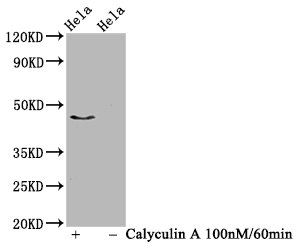
Validation in western blot applications demonstrates reliable detection in HeLa whole cell lysates, with testing performed on both Calyculin A-treated and untreated samples. This phosphatase inhibitor treatment comparison provides confidence that the antibody specifically recognizes the phosphorylated form of IRF3. The observed band at 47 kDa matches the predicted molecular weight, confirming target specificity. Recommended working dilutions between 1:500 and 1:5000 offer flexibility to optimize signal intensity based on your sample abundance and detection system.
For researchers investigating viral sensing mechanisms, inflammatory signaling cascades, or the broader landscape of innate immune activation, this antibody provides a dependable tool for monitoring IRF3 activation status in human samples. The combination of phospho-specificity and recombinant consistency makes it well-suited for studies where quantitative comparisons of pathway activation are central to experimental design.
There are currently no reviews for this product.





