
Call us
301-363-4651 (Available 9 a.m. to 5 p.m. CST from Monday to Friday)

| Code | CSB-RA018327A05phHU |
| Size | US$210 |
| Order now | |
| Image |
|
| Have Questions? | Leave a Message or Start an on-line Chat |
| Application | Recommended Dilution |
|---|---|
| WB | 1:500-1:5000 |
| IHC | 1:50-1:200 |
| IF | 1:20-1:200 |
RNA polymerase II, the enzyme responsible for transcribing protein-coding genes into mRNA, is regulated through dynamic phosphorylation of its largest subunit, POLR2A. Phosphorylation at serine 5 within the C-terminal domain heptad repeats serves as a critical marker of transcription initiation, recruiting capping enzymes and coordinating the transition from promoter clearance to productive elongation. Detecting this specific phosphorylation event provides researchers with a window into active transcriptional states and the regulatory mechanisms governing gene expression programs.
This recombinant monoclonal antibody, generated against a synthetic phosphopeptide corresponding to the Ser5-phosphorylated region of human POLR2A, offers the reproducibility essential for phospho-specific detection. Because recombinant production ensures a sequence-defined binding site and eliminates the lot-to-lot variability inherent in traditional hybridoma methods, researchers can confidently compare results across extended studies or between laboratories.
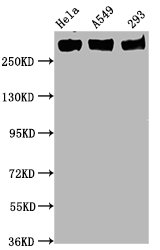
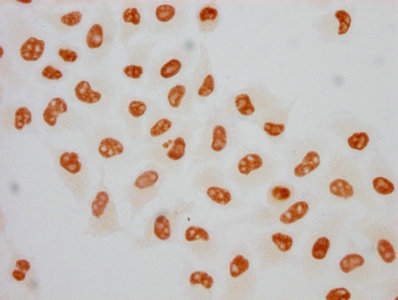
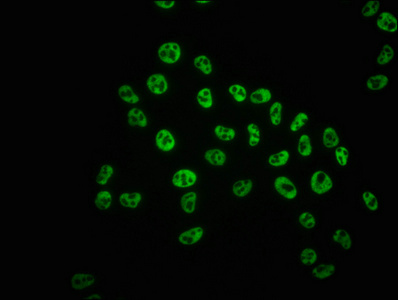
Validation across multiple experimental platforms demonstrates this antibody's versatility in your workflow. Western blot analysis detects a band at the expected 270 kDa molecular weight in HeLa, A549, and 293 whole cell lysates, confirming specificity for the full-length phosphorylated protein. Immunocytochemistry performed on EGF-stimulated HeLa cells reveals the expected nuclear localization pattern, while immunofluorescence staining with DAPI counterstaining provides clear visualization of phospho-POLR2A distribution within the nuclear compartment.
Whether investigating transcriptional regulation, chromatin dynamics, or signal-dependent gene activation, this antibody delivers reliable phospho-specific detection of a fundamental epigenetic marker. Its compatibility with western blotting, immunohistochemistry, and immunofluorescence applications supports diverse experimental approaches in transcription and nuclear signaling research.
There are currently no reviews for this product.





