
Call us
301-363-4651 (Available 9 a.m. to 5 p.m. CST from Monday to Friday)

| Code | CSB-RA018559A307phHU |
| Size | US$210 |
| Order now | |
| Image |
|
| Have Questions? | Leave a Message or Start an on-line Chat |
| Application | Recommended Dilution |
|---|---|
| WB | 1:500-1:5000 |
Protein phosphatase 2A (PP2A) serves as one of the major serine/threonine phosphatases in eukaryotic cells, regulating diverse cellular processes including cell cycle progression, DNA replication, and signal transduction pathways. The catalytic subunit alpha isoform, PPP2CA, is subject to critical post-translational modifications that modulate phosphatase activity. Phosphorylation at tyrosine 307 represents a key regulatory event that inactivates PP2A, making this modification particularly relevant for researchers investigating oncogenic signaling, growth factor responses, and the balance between kinase and phosphatase activities in disease states.
This recombinant monoclonal antibody, generated from clone 3F11, specifically recognizes the phosphorylated Y307 residue of human PPP2CA. As a sequence-defined recombinant antibody produced in rabbit, it offers the reproducibility essential for longitudinal studies and quantitative comparisons across experiments. Each lot delivers consistent performance, eliminating the variability that can complicate phospho-specific detection work.
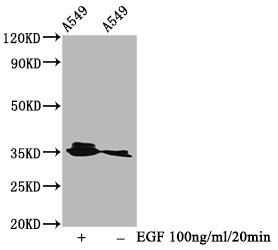
Western blot validation demonstrates reliable detection in A549 human lung adenocarcinoma cells, with clear visualization of the expected 35 kDa band corresponding to the predicted molecular weight of PPP2CA. Notably, testing included both EGF-treated and untreated lysates, providing researchers with a validated system for examining growth factor-induced phosphorylation dynamics. The recommended working dilution range of 1:500 to 1:5000 offers flexibility for optimization across different experimental conditions.
For investigators exploring signal transduction mechanisms, particularly those examining how PP2A inactivation contributes to sustained kinase signaling in cancer or growth factor biology, this phospho-specific antibody provides a well-characterized tool for monitoring this functionally significant modification.
There are currently no reviews for this product.





