
Call us
301-363-4651 (Available 9 a.m. to 5 p.m. CST from Monday to Friday)

| Code | CSB-RA805325A491phHU |
| Size | US$210 |
| Order now | |
| Image |
|
| Have Questions? | Leave a Message or Start an on-line Chat |
| Application | Recommended Dilution |
|---|---|
| WB | 1:500-1:5000 |
PRKAA2, the catalytic alpha-2 subunit of AMP-activated protein kinase, serves as a central metabolic sensor that orchestrates cellular energy homeostasis in response to nutrient availability and stress conditions. Phosphorylation at serine 491 represents a key regulatory modification that modulates AMPK activity, making detection of this specific phospho-site essential for researchers investigating metabolic signaling, autophagy regulation, and energy-dependent cellular processes.
This recombinant monoclonal antibody, generated against a synthetic phosphopeptide corresponding to the human Phospho-PRKAA2 S491 region, offers the reproducibility and consistency that phospho-specific detection demands. Because recombinant antibodies are produced from defined genetic sequences, you can expect uniform performance across experiments and over time, eliminating the lot-to-lot variability that can compromise longitudinal studies of dynamic phosphorylation events.
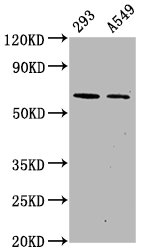
Validation by western blot demonstrates reliable detection in human cell lysates, with clear signal observed in both 293 and A549 cells at the predicted molecular weight of 62 kDa. This concordance between predicted and observed band size confirms specific recognition of the target without interference from post-translational modifications that might alter migration. The recommended working dilution range of 1:500 to 1:5000 provides flexibility to optimize signal-to-noise ratio across different sample preparations and detection systems. The antibody is also validated for ELISA, expanding its utility for quantitative applications.
For researchers exploring AMPK-mediated signal transduction, metabolic reprogramming in cancer models, or stress-responsive pathways, this phospho-specific antibody provides a dependable tool for monitoring S491 phosphorylation status in human experimental systems.
There are currently no reviews for this product.





