
Call us
301-363-4651 (Available 9 a.m. to 5 p.m. CST from Monday to Friday)

| Code | CSB-RA019386A807phHU |
| Size | US$210 |
| Order now | |
| Image |
|
| Have Questions? | Leave a Message or Start an on-line Chat |
| Application | Recommended Dilution |
|---|---|
| IF | 1:20-1:200 |
Retinoblastoma protein (RB1) serves as a master regulator of cell cycle progression, functioning as a critical tumor suppressor that controls the G1-to-S phase transition. Phosphorylation at serine 807 represents a key regulatory event, as cyclin-dependent kinase-mediated phosphorylation at this site contributes to RB1 inactivation and subsequent release of E2F transcription factors, permitting cells to proceed through the cell cycle. Detecting this specific phosphorylation event provides researchers with valuable insight into cell cycle dynamics, proliferation status, and the functional state of this essential checkpoint pathway.
This recombinant monoclonal antibody, generated against a synthetic phosphopeptide corresponding to human Phospho-RB1 at serine 807, offers the reproducibility and consistency that phospho-specific detection demands. Because recombinant antibodies are produced from defined sequences rather than hybridoma-derived sources, researchers benefit from lot-to-lot uniformity that is particularly important when tracking subtle changes in phosphorylation levels across experimental conditions or longitudinal studies.
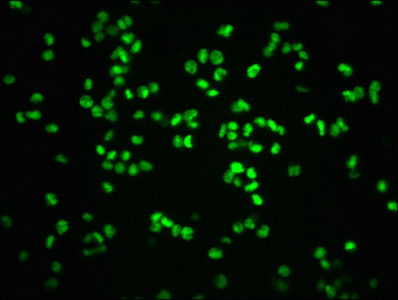
Validation in immunofluorescence applications demonstrates clear nuclear localization in K562 human chronic myelogenous leukemia cells, consistent with the expected subcellular distribution of this transcriptional regulator. The antibody performs effectively at dilutions ranging from 1:20 to 1:200 for immunofluorescence, providing flexibility to optimize signal intensity based on your specific experimental system and detection setup.
For researchers investigating cell cycle regulation, cancer biology, or proliferative signaling pathways, this antibody enables precise monitoring of RB1 phosphorylation status in human samples. Its suitability for both ELISA and immunofluorescence applications supports diverse experimental approaches, from quantitative biochemical analysis to spatial visualization of phosphorylation events within individual cells.
There are currently no reviews for this product.





