
Call us
301-363-4651 (Available 9 a.m. to 5 p.m. CST from Monday to Friday)

| Code | CSB-RA104640A0HU |
| Size | US$210 |
| Order now | |
| Image |
|
| Have Questions? | Leave a Message or Start an on-line Chat |
| Application | Recommended Dilution |
|---|---|
| WB | 1:500-1:2000 |
| IF | 1:50-1:200 |
| FC | 1:50-1:200 |
SFRP4 (Secreted frizzled-related protein 4) functions as a soluble modulator of Wnt signaling, a pathway fundamental to embryonic development, tissue homeostasis, and disease progression. By acting as a decoy receptor that sequesters Wnt ligands, SFRP4 influences processes ranging from adipogenesis and bone metabolism to tumor suppression. Its dysregulation has been implicated in metabolic disorders, cardiovascular disease, and various cancers, making it a compelling target for researchers investigating these interconnected biological systems.
This recombinant monoclonal antibody, generated in rabbit and derived from clone 14C1, offers the reproducibility and consistency that demanding research protocols require. Because recombinant antibodies are produced from defined sequences rather than traditional hybridoma methods, you can expect reliable performance across experiments and between lots, eliminating a common source of variability in longitudinal studies.
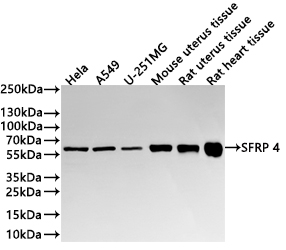
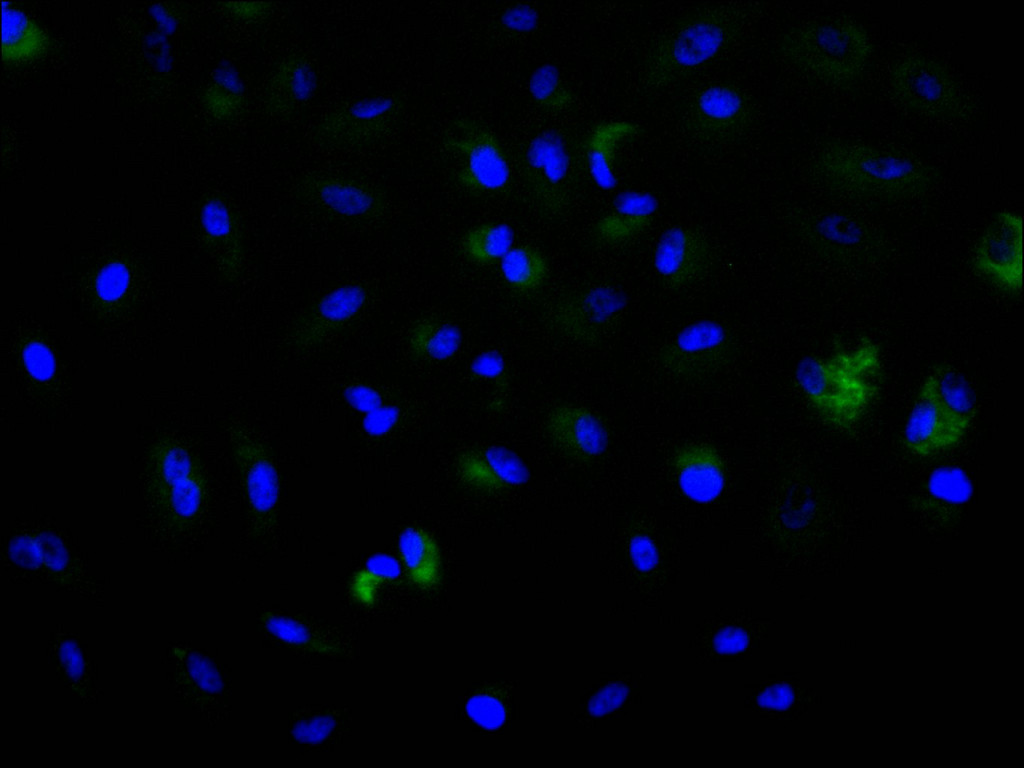
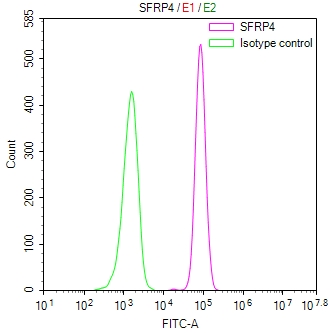
Validation data demonstrates robust performance across multiple experimental platforms. In western blot applications, the antibody detects SFRP4 in human cell lines including HeLa, A549, and U-251MG, as well as in mouse uterus and rat uterus and heart tissues, confirming cross-species reactivity. The observed band at approximately 60 kDa, rather than the predicted 40 kDa molecular weight, likely reflects post-translational glycosylation characteristic of secreted proteins. Immunofluorescence studies in A549 cells reveal clear cytoplasmic localization with minimal background, while flow cytometry analysis shows distinct positive population shifts compared to isotype controls.
With validated performance in ELISA, western blot, immunofluorescence, and flow cytometry, this antibody provides flexibility for researchers studying Wnt pathway modulation, metabolic signaling, or tumor microenvironment dynamics across human, mouse, and rat experimental systems.
There are currently no reviews for this product.





