TNFRSF19 Recombinant Monoclonal Antibody

Code CSB-RA119581A0HU
Size US$210
Order now
Image
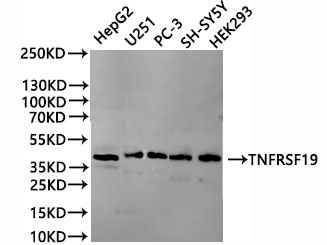
  • Western Blot
    Positive WB detected in: PC-3 whole cell lysate(30µg), U251 whole cell lysate(30µg), HepG2 whole cell lysate(30µg), HEK293 whole cell lysate(30µg), SY5Y whole cell lysate(30µg)
    All lanes: TNFRSF19 antibody at 1:1000
    Secondary
    Goat polyclonal to rabbit IgG at 1/40000 dilution
    Predicted band size: 46 kDa
    Observed band size: 46 kDa
    Exposure time:3min
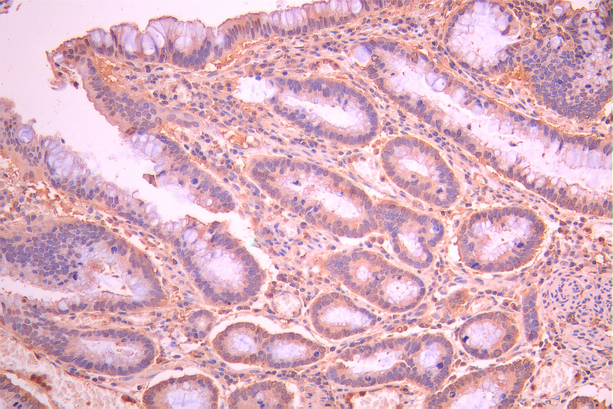
  • IHC image of CSB-RA119581A0HU diluted at 1:100 and staining in paraffin-embedded human small intestine tissue performed on a Leica BondTM system. After dewaxing and hydration, antigen retrieval was mediated by high pressure in a citrate buffer (pH 6.0). Section was blocked with 10% normal goat serum 30min at RT. Then primary antibody (1% BSA) was incubated at 4°C overnight. The primary is detected by a Goat anti-rabbit polymer IgG labeled by HRP and visualized using 0.05% DAB.
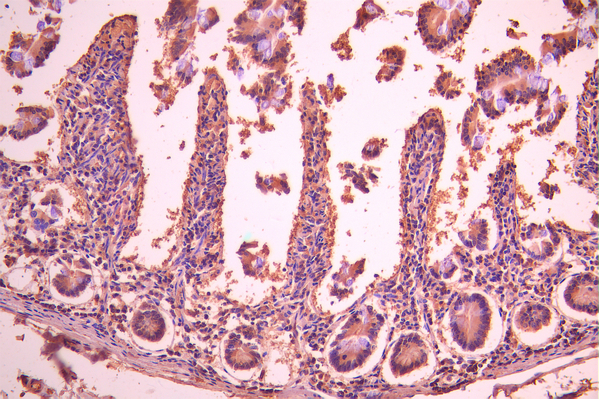
  • IHC image of CSB-RA119581A0HU diluted at 1:100 and staining in paraffin-embedded human gastric cancer performed on a Leica BondTM system. After dewaxing and hydration, antigen retrieval was mediated by high pressure in a citrate buffer (pH 6.0). Section was blocked with 10% normal goat serum 30min at RT. Then primary antibody (1% BSA) was incubated at 4°C overnight. The primary is detected by a Goat anti-rabbit polymer IgG labeled by HRP and visualized using 0.05% DAB.
  • Overlay Peak curve showing A431 cells stained with CSB-RA119581A0HU (red line) at 1:100. Then 10% normal goat serum to block non-specific protein-protein interactions followed by the antibody (1ug/1*106cells) for 45min at 4℃. The secondary antibody used was FITC-conjugated goat anti-rabbit IgG (H+L) at 1/200 dilution for 35min at 4℃.Control antibody (green line) was Rabbit IgG (1ug/1*106cells) used under the same conditions. Acquisition of >10,000 events was performed.
Have Questions? Leave a Message or Start an on-line Chat

Product Details

Uniprot No.
Target Names
TNFRSF19
Alternative Names
Tumor necrosis factor receptor superfamily member 19 (TRADE) (Toxicity and JNK inducer), TNFRSF19, TAJ TROY
Species Reactivity
Human
Immunogen
A synthesized peptide derived from Human TNFRSF19 protein
Immunogen Species
Homo sapiens (Human)
Conjugate
Non-conjugated
Clonality
Monoclonal
Isotype
Rabbit IgG
Clone No.
3B6
Purification Method
Affinity-chromatography
Concentration
It differs from different batches. Please contact us to confirm it.
Buffer
Rabbit IgG in 10mM phosphate buffered saline , pH 7.4, 150mM sodium chloride, 0.05% BSA, 0.02% sodium azide and 50% glycerol.
Form
Liquid
Tested Applications
ELISA, WB, IHC, FC
Recommended Dilution
Application Recommended Dilution
WB 1:500-1:5000
IHC 1:50-1:200
FC 1:20-1:200
Troubleshooting and FAQs
Storage
Upon receipt, store at -20°C or -80°C. Avoid repeated freeze.
Lead Time
Basically, we can dispatch the products out in 1-3 working days after receiving your orders. Delivery time maybe differs from different purchasing way or location, please kindly consult your local distributors for specific delivery time.
Usage
For Research Use Only. Not for use in diagnostic or therapeutic procedures.
Customer Reviews and Q&A

 Customer Reviews

There are currently no reviews for this product.

Submit a Review here

Target Background

Function
Can mediate activation of JNK and NF-kappa-B. May promote caspase-independent cell death.
Gene References into Functions
  1. TNFRSF19 may contribute to the development of colorectal tumors with deregulated beta-catenin activity. PMID: 24623448
  2. Results show aberrant expression and/or signaling by TROY as a contributor to the dispersion of glioblastoma cells and therapeutic resistance. PMID: 23699535
  3. the association of RhoGDIalpha with TROY contributed to TROY-dependent RhoA activation and neurite outgrowth inhibition after Nogo-66 stimulation. PMID: 24129566
  4. TROY is up-regulated in human colorectal cancer cell lines and in intestinal tumors in mice. It functions as a negative modulator of the Wnt pathway in LGR5-positive stem cells. PMID: 23142137
  5. study demonstrated that TNFR2 and TROY mRNA levels are enhanced in cutaneous squamous cell carcinoma cells compared to healthy ones in a Tunisian population PMID: 22057614
  6. TNFRSF19 overexpression in glioma cells activates Rac1 signaling in a Pyk2-dependent manner to drive glioma cell invasion and migration PMID: 20881009
  7. Findings provide new insights into the pathogenesis of NPC by highlighting the involvement of pathways related to TNFRSF19 and MDS1-EVI1 in addition to HLA molecules. PMID: 20512145
  8. TROY regulates melanoma growth. PMID: 17187358
  9. the ternary complex of NgR/TROY/LINGO-1 expressed on astrocytes, macrophages/microglia and neurones, by interacting with Nogo-A on oligodendrocytes, might modulate glial-neuronal interactions in demyelinating lesions of multiple sclerosis PMID: 17239012

Show More

Hide All

Subcellular Location
Membrane; Single-pass type I membrane protein.
Tissue Specificity
Highly expressed in prostate. Detected at lower levels in thymus, spleen, testis, uterus, small intestine, colon and peripheral blood leukocytes.
Database Links

HGNC: 11915

OMIM: 606122

KEGG: hsa:55504

STRING: 9606.ENSP00000371693

UniGene: Hs.149168

icon of phone
Call us
301-363-4651 (Available 9 a.m. to 5 p.m. CST from Monday to Friday)
icon of address
Address
7505 Fannin St., Ste 610, Room 7 (CUBIO Innovation Center), Houston, TX 77054, USA
icon of social media
Join us with

Subscribe newsletter

Leave a message

* To protect against spam, please pass the CAPTCHA test below.
CAPTCHA verification
© 2007-2026 CUSABIO TECHNOLOGY LLC All rights reserved. 鄂ICP备15011166号-1
Place an order now

I. Product details

*
*
*
*

II. Contact details

*
*

III. Ship To

*
*
*
*
*
*
*

IV. Bill To

*
*
*
*
*
*
*
*