


Call us
301-363-4651 (Available 9 a.m. to 5 p.m. CST from Monday to Friday)

Thank you for your continued support of CUSABIO! In April 2026, articles related to CUSABIO products were published in excess of 300. The total number of articles has now reached 31,000.
Thank you for choosing CUSABIO research products on your scientific research journey. Your trust and support are deeply appreciated. We will continue to work hard to provide you with even better products and services.
Now, let's take a moment to share these wonderful research results.

Impact Factor: 26.8
Journal Name: Advanced Materials
CUSABIO Citation Product:
Mouse Lipopolysaccharides(LPS) ELISA Kit; CSB-E13066m
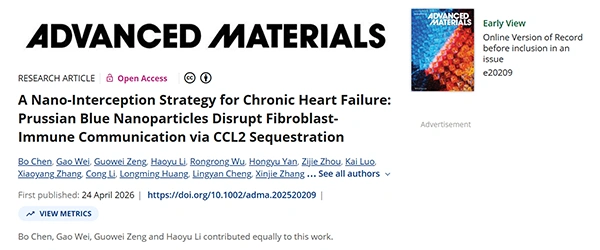
This study identifies POSTN⁺CCL2⁺ fibroblasts that drive CCR2⁺ macrophage recruitment via the CCL2-CCR2 axis in pressure-overloaded hearts. Prussian blue nanoparticles bind CCL2 via surface C≡N groups, inducing conformational distortion and ultra-high-affinity sequestration. This nano-interception disrupts fibroblast-macrophage crosstalk, reduces fibrosis, improves cardiac function in murine and porcine heart failure models, and avoids systemic immunosuppression.
Impact Factor: 21
Journal Name: European Respiratory Journal
CUSABIO Citation Product:
Mouse terminal complement complex C5b-9,TCC C5b-9 ELISA Kit; CSB-E08710m
HGF expression declines in advanced emphysema. Using clinical-stage SM102 lipid nanoparticles to deliver HGF mRNA via intratracheal or aerosol routes in elastase- and cigarette smoke-induced models restores alveolar structure and lung function by activating AKT-GSK3β-β-catenin signaling to promote AT2 cell proliferation and differentiation. The approach demonstrates good safety and therapeutic efficacy.
Impact Factor: 15.7
Journal Name: Nature Communications
CUSABIO Citation Product:
Mouse Osteocalcin/Bone gla protein,OT/BGP ELISA kit; CSB-E06917m
Mouse cross linked C-telopeptide of type I collagen (CTX-Ⅰ) ELISA Kit; CSB-E12782m
This study develops a NIR-activatable CRISPR/Cas13d system using upconversion nanoparticles to convert deep-penetrating 980 nm light to 470 nm, triggering CRY2PHR/CIBN-mediated split Cas13d reconstitution for RNA degradation or base editing. In a steroid-associated osteonecrosis model, targeting TET3 prevents osteocyte apoptosis and preserves bone microarchitecture with spatiotemporal precision and reversibility.
Impact Factor: 14.3
Journal Name: Autophagy
CUSABIO Citation Product:
DRAM2 Antibody; CSB-PA866601ESR2HU
RPS6KA3/RSK2 phosphorylates DRAM2 at Ser263, promoting AP-3-dependent lysosomal trafficking and autophagic flux. The non-phosphorylatable S263A mutant reroutes DRAM2 to the plasma membrane, enhances exosome secretion, impairs autophagy, and suppresses melanoma growth. This axis is upregulated in melanoma and correlates with poor prognosis, representing a therapeutic target.
Impact Factor: 14.1
Journal Name: Advanced Science
CUSABIO Citation Product:
Mouse CD81 antigen(CD81) ELISA kit; CSB-EL004960MO
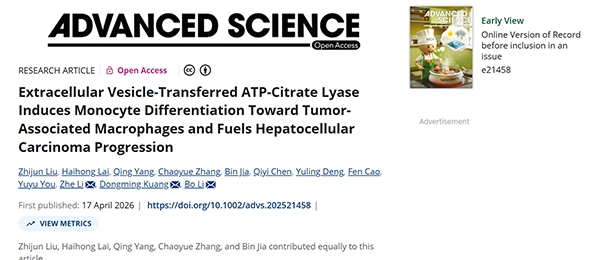
HCC-derived EVs deliver ACLY to monocytes via CD81, promoting palmitate synthesis, palmitoylation and stabilization of PD-L1 and CD276, inducing immunosuppressive TAM differentiation and HCC progression. CD81-coated liposomes delivering ACLY inhibitors synergize with anti-PD-L1 therapy, offering a promising strategy to enhance immunotherapy in HCC.
Impact Factor: 14.1
Journal Name: Advanced Science
CUSABIO Citation Product:
Human Lipopolysaccharides,LPS ELISA Kit; CSB-E09945h
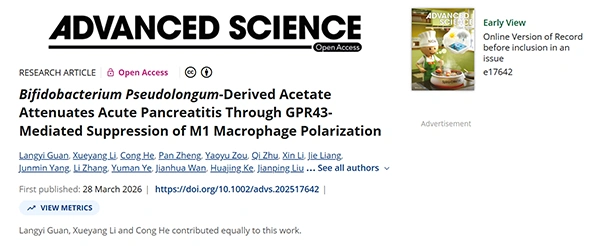
This study finds that Bifidobacterium pseudolongum alleviates pancreatic injury and improves gut barrier in acute pancreatitis (AP) mice, with acetate as its key metabolite synthesized via ackA gene. Acetate inhibits macrophage M1 polarization through GPR43 by downregulating JNK/NF-κB/STAT1 pathways to mitigate inflammation. Clinically, fecal B. pseudolongum and acetate levels are reduced in AP patients and negatively correlate with disease severity. It reveals a novel microbiota-metabolite-immune axis, providing probiotic and metabolite intervention strategies for AP.
Impact Factor: 13
Journal Name: Journal of Advanced Research
CUSABIO Citation Product:
Recombinant Acinetobacter baumannii Outer membrane protein Omp38 (omp38); CSB-EP754340ABS
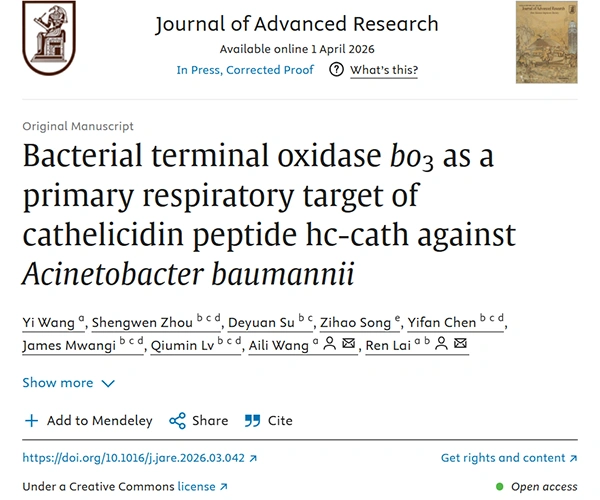
This study reveals that the sea snake-derived antimicrobial peptide hc-cath targets bacterial terminal oxidase bo3 in Acinetobacter baumannii. At low concentrations, it directly binds CyoB subunit, inhibits enzyme activity, collapses proton motive force, and induces lethal ROS burst; at high concentrations, it disrupts cell membranes. The peptide shows excellent in vitro and in vivo efficacy, and bo3-deficient strains exhibit significantly increased resistance. Its bactericidal effect is oxygen-dependent. This work first identifies bo3 as a respiratory target of AMPs, providing a novel strategy for developing anti-drug-resistant bacteria agents.
Impact Factor: 13.1
Journal Name: Nucleic Acids Research
CUSABIO Citation Product:
Recombinant Human Replication protein A 70kDa DNA-binding subunit (RPA1); CSB-EP020088HU
Recombinant Human Replication protein A 32 kDa subunit (RPA2), partial; CSB-BP020089HU1
Recombinant Human Replication protein A 14 kDa subunit (RPA3), partial; CSB-EP020091HUe0
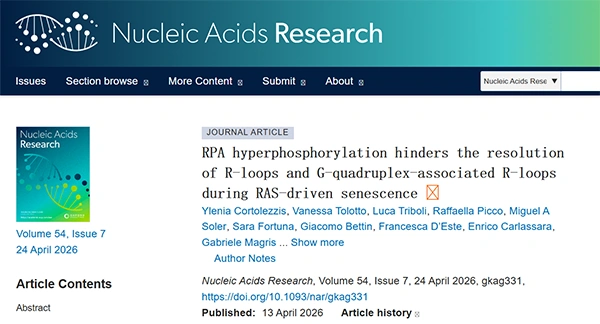
In RAS-driven senescence, cells accumulate abundant R-loops and G4-associated G-loops. Hyperphosphorylation of RPA32 disrupts RPA-RNase H1 interaction, impairing RNase H1 activity in resolving R-loops/G-loops, leading to unresolved structures and sustained DNA damage. Restoring RPA function promotes structure dissociation, alleviates damage, and enables senescence bypass. This study uncovers a novel mechanism by which the RPA phosphorylation-RNase H1 axis maintains non-B DNA homeostasis, offering targets for genome stability and senescence intervention under oncogenic stress.
Impact Factor: 12.5
Journal Name: Cell Discovery
CUSABIO Citation Product:
VANGL1 Antibody; CSB-PA848385ESR1HU
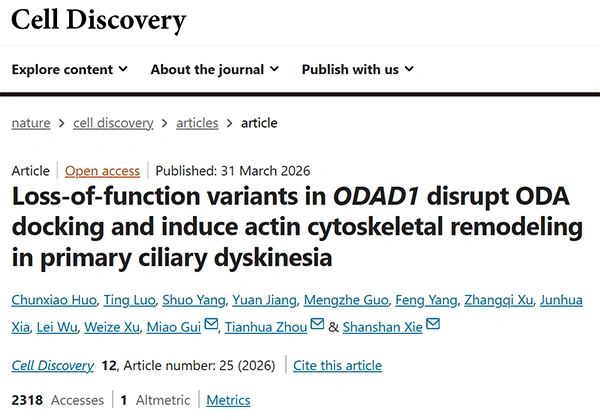
This study identifies novel homozygous loss-of-function and splicing variants of ODAD1 in primary ciliary dyskinesia (PCD) patients, causing complete outer dynein arm docking loss and severe ciliary motility defects. ODAD1 deficiency also triggers aberrant actin cytoskeletal remodeling, reducing multiciliated cell abundance and disrupting basal body orientation; cytochalasin B partially rescues these phenotypes. Lentiviral rescue with wild-type ODAD1 restores ciliary structure and beating. It reveals ODAD1’s dual role in regulating ciliary structure and epithelial actin homeostasis, providing new mechanisms and targets for PCD diagnosis and therapy.
Impact Factor: 12.5
Journal Name: Science Advances
CUSABIO Citation Product:
Mouse Interleukin 1β, IL-1β ELISA Kit; CSB-E08054m
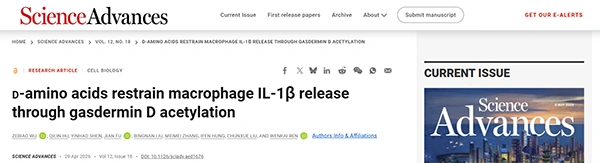
This study reveals that LPS inhibits DAAO/DDO expression via NF-κB in macrophages, increasing intracellular D-amino acids. D-amino acids directly bind and activate mitochondrial PDH to promote acetyl-CoA production, inducing GSDMD-K146 acetylation and blocking its oligomerization, thereby suppressing IL-1β release. Supplementation with D-Ala/D-Glu or myeloid-specific DDO deletion alleviates sepsis in mice. It uncovers a novel mechanism by which D-amino acids regulate macrophage inflammation through acetylation, offering potential therapeutic strategies for related inflammatory diseases.


