
Call us
301-363-4651 (Available 9 a.m. to 5 p.m. CST from Monday to Friday)

| Code | CSB-E08183m-IS |
| Size | 96T,5×96T,10×96T |
| Price | Request a Quote |
| Trial Size |
24T ELISA Kit Trial Size (Only USD$150/ kit) * Sample kit cost can be deducted as a $30 credit for each 96-assay kit of the same analyte and brand you subsequently purchase within six months until depleted. More details >> Interested in a trial size? Please leave a message below.
|
| Have Questions? | Leave a Message or Start an on-line Chat |
Intra-assay Precision (Precision within an assay): CV%<8% | ||||||
Three samples of known concentration were tested twenty times on one plate to assess. | ||||||
Inter-assay Precision (Precision between assays): CV%<10% | ||||||
Three samples of known concentration were tested in twenty assays to assess. | ||||||
To assess the linearity of the assay, samples were spiked with high concentrations of mouse IP-10 in various matrices and diluted with the Sample Diluent to produce samples with values within the dynamic range of the assay. | ||||||
| Sample | Serum(n=4) | ||||
1:4 | Average % | 98 | ||||
Range % | 91-104 | |||||
1:8 | Average % | 94 | ||||
Range % | 89-99 | |||||
1:16 | Average % | 105 | ||||
Range % | 100-111 | |||||
1:32 | Average % | 90 | ||||
Range % | 85-96 | |||||
The recovery of mouse IP-10 spiked to levels throughout the range of the assay in various matrices was evaluated. Samples were diluted prior to assay as directed in the Sample Preparation section. | ||||||
Sample Type | Average % Recovery | Range | ||||
Serum (n=5) | 98 | 91-105 | ||||
EDTA plasma (n=4) | 90 | 85-96 | ||||
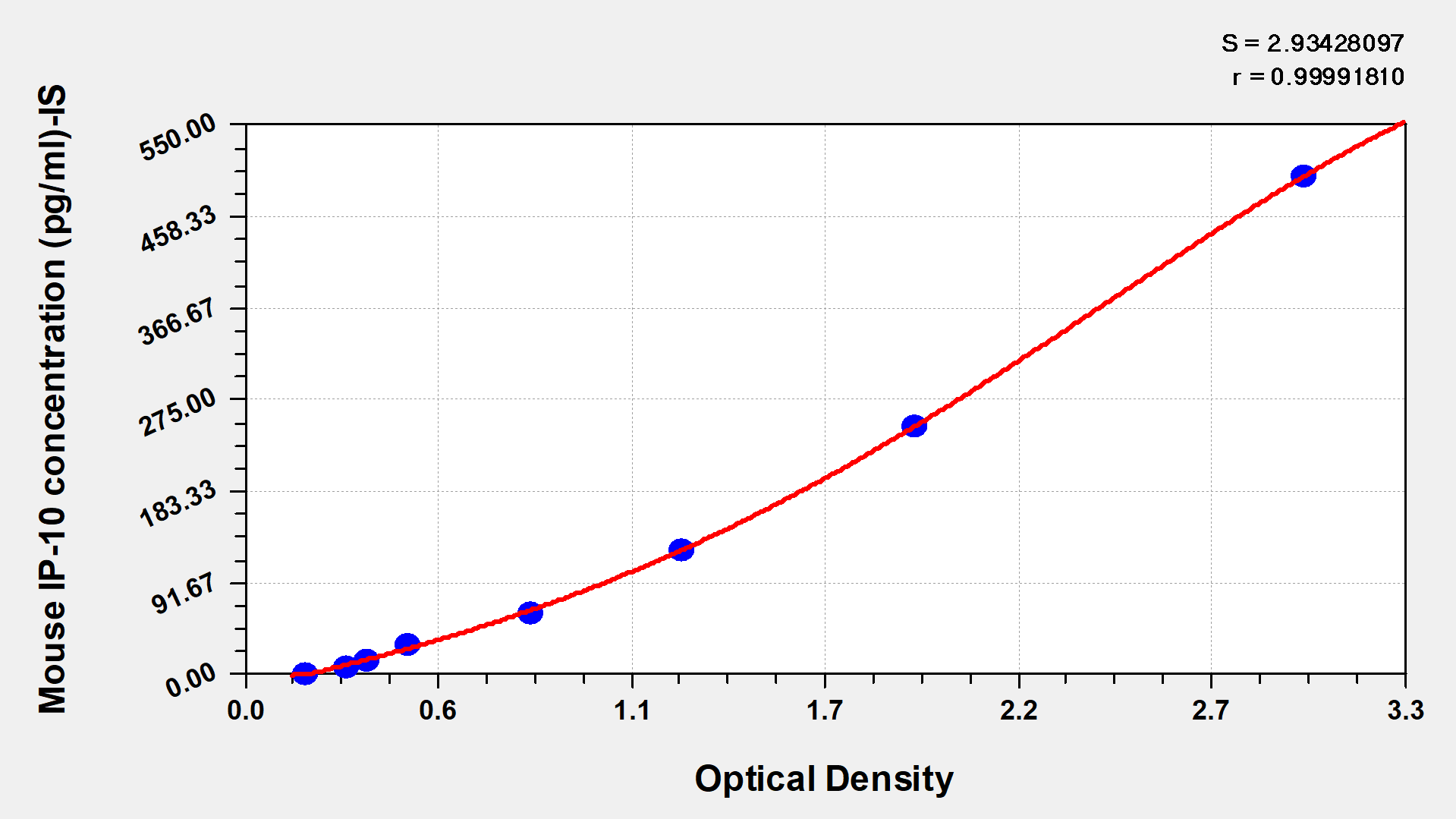
These standard curves are provided for demonstration only. A standard curve should be generated for each set of samples assayed. | |||||||
| |||||||
pg/ml | OD1 | OD2 | Average | Corrected | |||
500 | 3.083 | 2.934 | 3.009 | 2.822 | |||
250 | 1.954 | 1.867 | 1.911 | 1.723 | |||
125 | 1.267 | 1.228 | 1.248 | 1.060 | |||
62.5 | 0.815 | 0.829 | 0.822 | 0.635 | |||
31.2 | 0.482 | 0.471 | 0.477 | 0.289 | |||
15.6 | 0.369 | 0.353 | 0.361 | 0.174 | |||
7.8 | 0.304 | 0.304 | 0.304 | 0.117 | |||
0 | 0.189 | 0.185 | 0.187 |
| |||
This Mouse CXCL10 (IP-10) ELISA Kit provides quantitative measurement of CXCL10 in Mus musculus samples, supporting research into interferon-γ-driven immune signaling and chemokine-mediated T cell recruitment. Because CXCL10 levels can shift dramatically between baseline and inflammatory states, the kit is designed to capture this dynamic range without requiring multiple dilution schemes.
Detection Range: The 7.8–500 pg/mL range spans resting-state serum CXCL10 concentrations in naïve mice (typically 20–80 pg/mL) through the elevated levels seen during viral infection or tumor-driven inflammation (often 200–500+ pg/mL), meaning most samples can be run neat or with minimal dilution.
Sensitivity: At 3.9 pg/mL, the kit detects CXCL10 in low-abundance contexts such as conditioned media from unstimulated splenocytes or early-phase innate immune responses before IFN-γ amplification drives robust chemokine production.
Sample Compatibility: Validation across serum, plasma, and tissue homogenates enables researchers to correlate circulating CXCL10 with local expression in inflamed tissues—critical for dissecting compartmentalized immune responses in organs like lung, liver, or tumor microenvironment.
Assay Efficiency: The 50–100 µL sample volume and 1–5 hour protocol accommodate limited-volume mouse bleeds and same-day processing of tissue panels from multi-timepoint infection or treatment studies.
This kit is well-suited for studies of viral immunopathology, graft rejection, and CXCR3-dependent antitumor immunity.
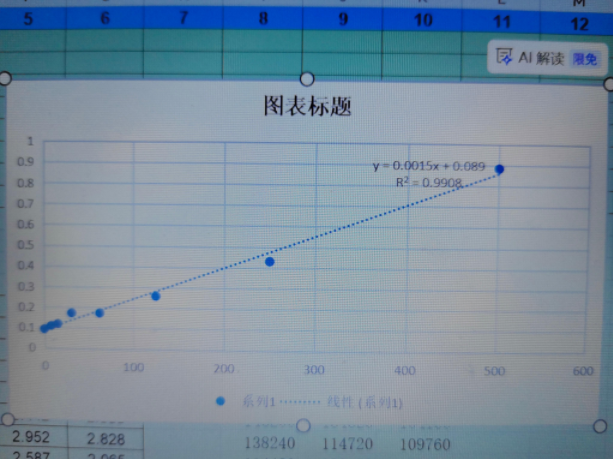
Sample type: Other: Tumor interstitial fluid (TIF)
Sample species: Mouse
Sample dilution: 1:50
Review: CSB-E08183m-IS was used to detect normal tumor interstitial fluid. The OD values of the standard curve were 0.092, 0.109, 0.119, 0.173, 0.258, and 0.884, and the OD values of the samples ranged from 2.4 to 3.8. The standard curve was y=0.0016x+0.0848 with R²=0.9977. The detection results were relatively accurate, and the operation steps in the instruction manual were clear and easy to understand. All eight points were tested, but two points were deleted for better linearity, which did not affect the overall experimental results.
By Anonymous





