Purity
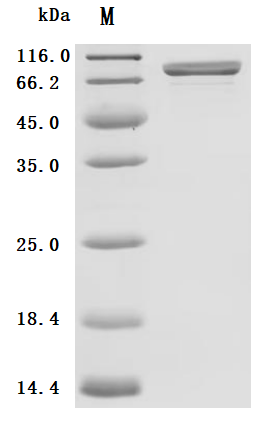
≥ 95% as determined by SDS-PAGE.
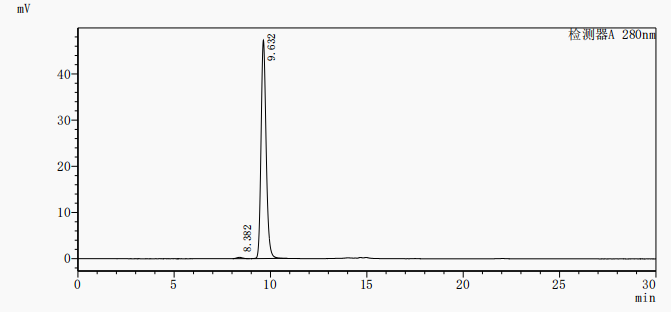
≥ 95% as determined by SEC-HPLC.
Endotoxin
Less than 1.0 EU/ug as determined by LAL method.
Activity
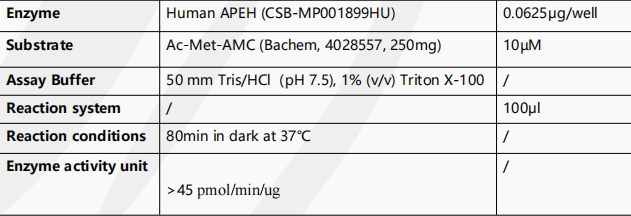
Measured by its ability to hydrolyze the fluorogenic substrate Ac-Met-AMC. The specific activity is >45 pmol/min/μg.
Alternative Names
Acylamino-acid-releasing enzyme; AARE; EC 3.4.19.1; Acyl-peptide hydrolase; APH; Acylaminoacyl-peptidase; Oxidized protein hydrolase; OPH
Species
Homo sapiens (Human)
Expression Region
1-732aa
Target Protein
Sequence
MERQVLLSEPEEAAALYRGLSRQPALSAACLGPEVTTQYGGQYRTVHTEWTQRDLERMENIRFCRQYLVFHDGDSVVFAGPAGNSVETRGELLSRESPSGTMKAVLRKAGGTGPGEEKQFLEVWEKNRKLKSFNLSALEKHGPVYEDDCFGCLSWSHSETHLLYVAEKKRPKAESFFQTKALDVSASDDEIARLKKPDQAIKGDQFVFYEDWGENMVSKSIPVLCVLDVESGNISVLEGVPENVSPGQAFWAPGDAGVVFVGWWHEPFRLGIRFCTNRRSALYYVDLIGGKCELLSDDSLAVSSPRLSPDQCRIVYLQYPSLIPHHQCSQLCLYDWYTKVTSVVVDVVPRQLGENFSGIYCSLLPLGCWSADSQRVVFDSAQRSRQDLFAVDTQVGTVTSLTAGGSGGSWKLLTIDQDLMVAQFSTPSLPPTLKVGFLPSAGKEQSVLWVSLEEAEPIPDIHWGIRVLQPPPEQENVQYAGLDFEAILLQPGSPPDKTQVPMVVMPHGGPHSSFVTAWMLFPAMLCKMGFAVLLVNYRGSTGFGQDSILSLPGNVGHQDVKDVQFAVEQVLQEEHFDASHVALMGGSHGGFISCHLIGQYPETYRACVARNPVINIASMLGSTDIPDWCVVEAGFPFSSDCLPDLSVWAEMLDKSPIRYIPQVKTPLLLMLGQEDRRVPFKQGMEYYRALKTRNVPVRLLLYPKSTHALSEVEVESDSFMNAVLWLRTHLGS
Protein Length
Full Length
Tag Info
C-terminal 10xHis-tagged
Form
Lyophilized powder
Note: We will preferentially ship the format that
we have in stock, however, if you have any special requirement for the format, please remark your
requirement when placing the order, we will prepare according to your demand.
Buffer
Lyophilized from a 0.2 μm sterile filtered PBS, 6% Trehalose, pH 7.4
Reconstitution
We recommend that this vial be briefly centrifuged prior to opening to bring the contents to the bottom. Please reconstitute protein in deionized sterile water to a concentration of 0.1-1.0 mg/mL.We recommend to add 5-50% of glycerol (final concentration) and aliquot for long-term storage at -20°C/-80°C. Our default final concentration of glycerol is 50%. Customers could use it as reference.
Storage Condition
Store at -20°C/-80°C upon receipt, aliquoting is necessary for mutiple use. Avoid
repeated freeze-thaw
cycles.
Shelf Life
The shelf life is related to many factors, storage state, buffer ingredients, storage
temperature
and the stability of the protein itself.
Generally, the shelf life of liquid form is 6 months at -20°C/-80°C. The shelf life of lyophilized
form is 12 months at -20°C/-80°C.
Lead Time
Basically, we can dispatch the products out in 3-7 working days after receiving your orders. Delivery time may differ from different purchasing way or location, please kindly consult your local distributors for specific delivery time.
Notes
Repeated freezing and thawing is not recommended. Store working aliquots at 4℃ for up to one week.
Datasheet & COA
Please contact us to get it.