
Call us
301-363-4651 (Available 9 a.m. to 5 p.m. CST from Monday to Friday)

| Code | CSB-MP008759HU-WD |
| Abbreviation | Recombinant Human FN1 protein, partial (Active) |
| MSDS | |
| Size | Inquiry |
| Order now | |
| Image |
|
| Have Questions? | Leave a Message or Start an on-line Chat |
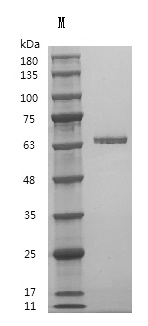
Fibronectin's capacity to mediate cell–matrix interactions depends critically on the structural integrity of its integrin-binding and heparin-binding domains, both of which are represented in this fragment spanning residues 1270–1546 and 1721–2016. Mammalian expression preserves the native glycosylation and disulfide architecture required for functional receptor engagement, as demonstrated by the protein's ability to stimulate B16-F1 melanoma cell adhesion with an ED50 of 35.0–420 ng/mL—a range that supports dose-response studies in cancer invasion models, wound healing assays, and integrin-binding experiments. This quantitative adhesion activity provides a suitable basis for coating surfaces in 3D culture systems, evaluating integrin αvβ3 or α5β1 interactions, and modeling fibrotic or metastatic microenvironments where fibronectin deposition drives pathological remodeling. Purity exceeding 95% by SDS-PAGE and endotoxin levels ≤10 EU/mg align with standards expected in cell-based functional assays and antibody validation protocols.
There are currently no reviews for this product.





