
Call us
301-363-4651 (Available 9 a.m. to 5 p.m. CST from Monday to Friday)

| Code | CSB-RA903884A0HU |
| Size | US$210 |
| Order now | |
| Image |
|
| Have Questions? | Leave a Message or Start an on-line Chat |
| Application | Recommended Dilution |
|---|---|
| FC | 1:50-1:200 |
Acetyl-CoA carboxylase alpha (ACACA) catalyzes the rate-limiting step in de novo fatty acid biosynthesis, converting acetyl-CoA to malonyl-CoA. This biotin-dependent enzyme serves as a critical metabolic node linking energy metabolism to lipid synthesis, making it a compelling target for cardiovascular research and studies exploring metabolic regulation in disease states. ACACA activity influences cellular energy homeostasis and has implications for understanding conditions where lipid metabolism becomes dysregulated.
This recombinant monoclonal antibody, clone 12E12, offers the consistency and reliability that demanding experimental workflows require. Developed using recombinant technology with a defined sequence, this rabbit IgG eliminates the lot-to-lot variability that can compromise longitudinal studies or multi-site collaborations. The antibody was raised against a synthetic peptide derived from human ACACA protein and purified through affinity chromatography, ensuring high specificity for your target.
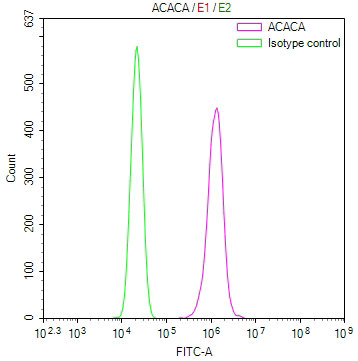
Validation in flow cytometry demonstrates robust detection of ACACA in PC-3 cells, a human prostate cancer cell line. Testing at 1:100 dilution with fixed and permeabilized cells produced clear signal separation from isotype control, confirming reliable intracellular detection. Recommended working dilutions range from 1:50 to 1:200 for flow cytometry applications, with ELISA compatibility providing additional experimental flexibility for quantitative analyses.
The unconjugated format allows researchers to pair this antibody with their preferred secondary detection systems, accommodating diverse experimental designs. For investigators studying metabolic pathways in cardiovascular biology or examining ACACA's role in cellular energy regulation, this antibody delivers the reproducible performance essential for generating publication-quality data across multiple experimental approaches.
There are currently no reviews for this product.





