
Call us
301-363-4651 (Available 9 a.m. to 5 p.m. CST from Monday to Friday)

| Code | CSB-RA257443A0HU |
| Size | US$210 |
| Order now | |
| Image |
|
| Have Questions? | Leave a Message or Start an on-line Chat |
| Application | Recommended Dilution |
|---|---|
| WB | 1:500-1:5000 |
AGTR1, the type-1 angiotensin II receptor, serves as a critical mediator of the renin-angiotensin system, transducing signals that regulate blood pressure, fluid balance, and cellular proliferation. Beyond its well-established cardiovascular functions, AGTR1 has emerged as a molecule of significant interest in cancer biology, where its expression patterns and signaling activities may influence tumor progression and metabolic reprogramming. For researchers investigating these pathways, reliable detection of this G protein-coupled receptor is essential for advancing mechanistic understanding.
This recombinant monoclonal antibody, clone 4A9, offers the reproducibility that demanding research requires. Produced using recombinant technology with a defined sequence, it eliminates the lot-to-lot variability that can compromise longitudinal studies and multi-site collaborations. The rabbit host and monoclonal nature ensure high specificity, while affinity chromatography purification delivers consistent performance across experiments.
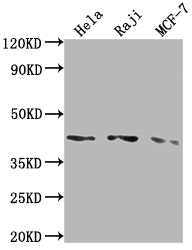
Validation in western blot applications demonstrates robust detection of AGTR1 at the expected 42 kDa molecular weight across multiple human cell lines, including HeLa, Raji, and MCF-7. This diversity of validated samples—spanning cervical carcinoma, B lymphocyte, and breast adenocarcinoma origins—provides confidence when working with various human cellular models. The recommended working dilution range of 1:500 to 1:5000 offers flexibility to optimize signal-to-background ratios for your specific experimental conditions, while ELISA compatibility extends utility to quantitative detection workflows.
Whether your work focuses on cardiovascular signaling mechanisms, metabolic regulation, or the emerging roles of angiotensin receptors in oncology, this antibody provides a dependable tool for interrogating AGTR1 expression in human samples.
There are currently no reviews for this product.





