
Call us
301-363-4651 (Available 9 a.m. to 5 p.m. CST from Monday to Friday)

| Code | CSB-RA699080A0HU |
| Size | US$210 |
| Order now | |
| Image |
|
| Have Questions? | Leave a Message or Start an on-line Chat |
| Application | Recommended Dilution |
|---|---|
| IHC | 1:50-1:200 |
| FC | 1:50-1:200 |
APAF1 (Apoptotic Protease-Activating Factor 1) serves as a critical molecular scaffold in the intrinsic apoptosis pathway, where it oligomerizes to form the apoptosome complex upon cytochrome c release from mitochondria. This assembly activates caspase-9, initiating the proteolytic cascade that executes programmed cell death. Understanding APAF1 expression and localization provides valuable insights into apoptotic regulation, making it a significant target for researchers investigating cell death mechanisms, cancer biology, and therapeutic resistance.
This recombinant monoclonal antibody, clone 18D10, offers the consistency and reproducibility that demanding experimental workflows require. Generated against a synthetic peptide derived from human APAF1, the antibody is produced using recombinant technology, ensuring sequence-defined specificity and eliminating the lot-to-lot variability often encountered with traditional hybridoma-derived reagents. This reliability proves particularly valuable when establishing long-term studies or comparing results across experiments.
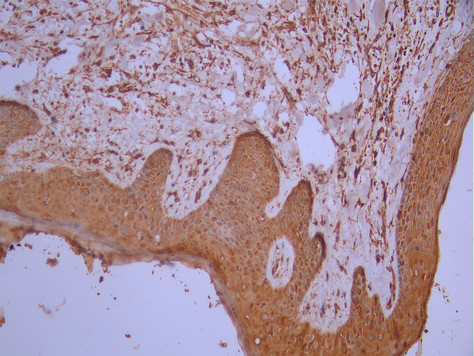
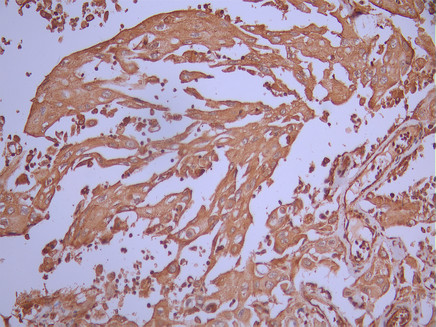
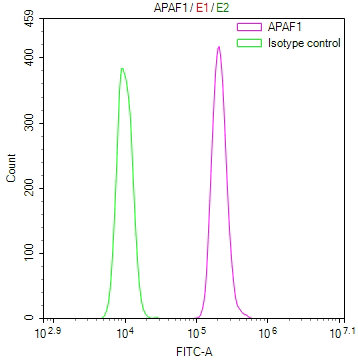
Validation studies demonstrate robust performance across multiple applications. Immunohistochemistry testing in paraffin-embedded human tissues, including skin and cervical cancer samples, shows reliable detection at 1:100 dilution using citrate buffer antigen retrieval. Flow cytometry analysis in HeLa cells confirms intracellular detection capability, with clear signal separation from isotype controls when cells are fixed and permeabilized. These validated applications provide flexibility for researchers examining APAF1 in both tissue architecture contexts and single-cell analyses.
The unconjugated format allows pairing with detection systems of your choice, supporting integration into established laboratory protocols. Whether investigating apoptotic pathway dysregulation in tumor samples or characterizing cell death responses in cultured cells, this antibody delivers the performance consistency essential for meaningful cell biology research.
There are currently no reviews for this product.





