

Call us
301-363-4651 (Available 9 a.m. to 5 p.m. CST from Monday to Friday)

| Code | CSB-RA180895A0MO |
| Size | US$210 |
| Order now | |
| Image |
|
| Have Questions? | Leave a Message or Start an on-line Chat |
| Application | Recommended Dilution |
|---|---|
| WB | 1:500-1:2000 |
| IHC | 1:50-1:200 |
| FC | 1:50-1:200 |
BAD (Bcl-2-associated death promoter) serves as a critical regulator of apoptosis, functioning as a pro-apoptotic member of the Bcl-2 protein family. By binding to and inhibiting anti-apoptotic proteins such as Bcl-XL and Bcl-2, BAD promotes programmed cell death and plays a significant role in determining cell fate decisions. This regulatory function makes BAD a key target in cancer research, where dysregulation of apoptotic pathways contributes to tumor survival and therapeutic resistance.
This recombinant monoclonal antibody, clone 19D1, offers researchers the consistency and reliability that comes with sequence-defined production. Unlike traditional hybridoma-derived antibodies, recombinant technology ensures lot-to-lot reproducibility, allowing you to generate comparable data across extended studies without concerns about antibody variability affecting your results.
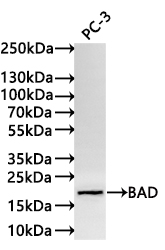
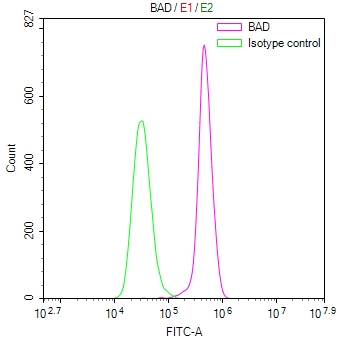
The antibody has been validated across multiple detection platforms, providing flexibility for diverse experimental workflows. Western blot analysis demonstrates specific detection of BAD at the expected 18 kDa molecular weight in PC-3 prostate cancer cell lysates, with recommended dilutions ranging from 1:500 to 1:2000. Immunohistochemistry validation in paraffin-embedded human melanoma tissue confirms utility for examining BAD expression in clinical specimens, while flow cytometry analysis in HeLa cells enables quantitative assessment of intracellular BAD levels in cell populations.
Supplied in a glycerol-containing buffer for stability, this affinity-purified rabbit IgG antibody is well-suited for researchers investigating apoptotic signaling, cancer biology, and therapeutic mechanisms targeting cell death pathways. Its demonstrated performance across complementary techniques supports comprehensive characterization of BAD expression and localization in human samples.
There are currently no reviews for this product.





