
Call us
301-363-4651 (Available 9 a.m. to 5 p.m. CST from Monday to Friday)

| Code | CSB-RA004775MA2HU |
| Size | $49.9 |
| Order now | |
| Promotion |

|
| Image |
|
| Have Questions? | Leave a Message or Start an on-line Chat |
| Application | Recommended Dilution |
|---|---|
| FC | 1:50-1:200 |
CCL11, commonly known as eotaxin-1, serves as a potent chemoattractant that plays a central role in eosinophil recruitment to sites of allergic inflammation. This C-C motif chemokine is critically involved in the pathophysiology of asthma, atopic dermatitis, and other eosinophil-mediated inflammatory conditions, making it an important target for researchers investigating allergic disease mechanisms, immune cell trafficking, and inflammatory signaling pathways.
This recombinant monoclonal antibody against human CCL11 offers the reproducibility and consistency that demanding experimental workflows require. Generated using recombinant technology and produced as clone 22H11, this antibody provides a sequence-defined reagent that eliminates the lot-to-lot variability often encountered with traditional hybridoma-derived antibodies. The human IgG1 isotype format and affinity chromatography purification ensure high purity suitable for sensitive detection applications.
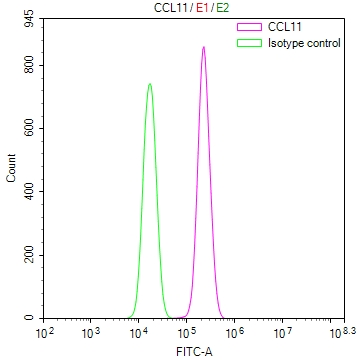
Validation studies demonstrate reliable performance in flow cytometry applications, with recommended dilutions ranging from 1:50 to 1:200. Testing in A549 cells stimulated with interferon-gamma confirmed specific intracellular detection of CCL11, with clear separation from isotype control signals when cells were fixed and permeabilized. This antibody is also validated for ELISA applications, providing flexibility across different experimental platforms.
The unconjugated format allows researchers to select secondary detection systems optimized for their specific instrumentation and experimental design. Supplied in a glycerol-based PBS buffer for stability, this antibody supports investigations into eosinophilic inflammation, chemokine biology, and the development of therapeutic strategies targeting allergic and inflammatory diseases where CCL11-mediated cell recruitment contributes to tissue pathology.
There are currently no reviews for this product.





