CEACAM8 Recombinant Monoclonal Antibody

Code CSB-RA937940A0HU
Size US$210
Order now
Image
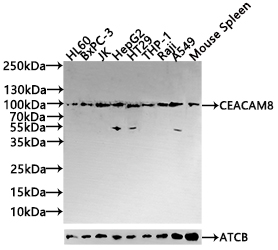
  • Western Blot
    Positive WB detected in: JK whole cell lysate(30µg), HepG2 whole cell lysate(30µg), HT29 whole cell lysate(30µg), THP-1 whole cell lysate(30µg), A549 whole cell lysate(30µg)
    All lanes: CEACAM8 antibody at 1:1000
    Secondary
    Goat polyclonal to rabbit IgG at 1/40000 dilution
    Predicted band size: 39, 70-100 kDa
    Observed band size: 100 kDa
    Exposure time: 120s
Have Questions? Leave a Message or Start an on-line Chat

Product Details

Uniprot No.
Target Names
Alternative Names
Carcinoembryonic antigen-related cell adhesion molecule 8 (CD67 antigen) (Carcinoembryonic antigen CGM6) (Non-specific cross-reacting antigen NCA-95) (CD antigen CD66b), CEACAM8, CGM6
Species Reactivity
Human
Immunogen
A synthesized peptide derived from Human CEACAM8
Immunogen Species
Homo sapiens (Human)
Conjugate
Non-conjugated
Clonality
Monoclonal
Isotype
Rabbit IgG
Clone No.
24H12
Purification Method
Affinity-chromatography
Concentration
It differs from different batches. Please contact us to confirm it.
Buffer
Rabbit IgG in 10mM phosphate buffered saline , pH 7.4, 150mM sodium chloride, 0.05% BSA, 0.02% sodium azide and 50% glycerol.
Form
Liquid
Tested Applications
ELISA, WB
Recommended Dilution
Application Recommended Dilution
WB 1:500-1:2000
Troubleshooting and FAQs
Storage
Upon receipt, store at -20°C or -80°C. Avoid repeated freeze.
Lead Time
Basically, we can dispatch the products out in 1-3 working days after receiving your orders. Delivery time maybe differs from different purchasing way or location, please kindly consult your local distributors for specific delivery time.
Description

CEACAM8, also known as CD66b, is a glycosylphosphatidylinositol-anchored member of the carcinoembryonic antigen family that plays a significant role in neutrophil activation and adhesion processes. As a marker predominantly expressed on granulocytes, CEACAM8 has become an important target for researchers investigating innate immune responses, inflammatory conditions, and neutrophil biology. Its involvement in cell-cell interactions and signal transduction makes it a valuable focus for immunology studies exploring leukocyte function and disease mechanisms.

This recombinant monoclonal antibody, clone 24H12, offers the consistency and reliability that demanding experimental workflows require. Produced using recombinant technology in rabbit host, this antibody provides sequence-defined specificity against a synthesized peptide derived from human CEACAM8, ensuring reproducible results across experiments and eliminating the lot-to-lot variability that can complicate long-term research projects. The affinity-chromatography purification process delivers a high-purity reagent suitable for sensitive detection applications.

Validation studies demonstrate robust performance in Western blot analysis across multiple human cell lines, including JK, HepG2, HT29, THP-1, and A549 lysates. The observed band at approximately 100 kDa aligns with the higher predicted molecular weight range, reflecting the extensive glycosylation characteristic of CEACAM family members. This antibody is also validated for ELISA and flow cytometry applications, with recommended dilutions of 1:50-1:200 for flow cytometry, providing flexibility for researchers working across different experimental platforms.

For investigators studying neutrophil biology, inflammatory responses, or immune cell characterization, this CEACAM8 antibody delivers the specificity and reproducibility essential for generating publication-quality data.

Usage
For Research Use Only. Not for use in diagnostic or therapeutic procedures.

Customer Reviews and Q&A

 Customer Reviews

There are currently no reviews for this product.

Submit a Review here

Target Background

Function
Cell surface glycoprotein that plays a role in cell adhesion in a calcium-independent manner. Mediates heterophilic cell adhesion with other carcinoembryonic antigen-related cell adhesion molecules, such as CEACAM6. Heterophilic interaction with CEACAM8 occurs in activated neutrophils.
Gene References into Functions
  1. Increased CD66b positive tumor-infiltrating neutrophils (CD66b + TINs) was significantly associated with presence of metastasis, S stage, and nonseminomatous germ cell tumor diagnosis. PMID: 27863478
  2. Data suggest ways in which carcinoembryonic antigen-related cell adhesion molecules CEACAM6 and CEACAM8 regulate the biological functions of one another. PMID: 26483485
  3. Granulocytes from type 2 diabetes patients display higher granulocyte cell surface expression of CD66b compared with values of healthy controls. PMID: 23686079
  4. The highly elevated gene expression of CEACAM6 and CEACAM8 in primary myelofibrosis can serve as molecular markers of myelofibrotic transformation. PMID: 21470677
  5. All the leukemic samples showed overexpression of CEACAM6 and 8 when compared with normal granulocytes. PMID: 17909799
  6. CD66b molecules are involved in regulating adhesion and activation of eosinophils, possibly through their localization in lipid rafts and interaction with other cell surface molecules, such as CD11b. PMID: 18056392

Show More

Hide All

Subcellular Location
Cell membrane; Lipid-anchor, GPI-anchor. Cell surface.
Protein Families
Immunoglobulin superfamily, CEA family
Tissue Specificity
Expressed in leukocytes of chronic myeloid Leukemia patients and bone marrow.
Database Links

HGNC: 1820

OMIM: 615747

KEGG: hsa:1088

STRING: 9606.ENSP00000244336

UniGene: Hs.41

icon of phone
Call us
301-363-4651 (Available 9 a.m. to 5 p.m. CST from Monday to Friday)

icon of address
Address
7505 Fannin St., Ste 610, Room 7 (CUBIO Innovation Center), Houston, TX 77054, USA
icon of social media
Join us with

Subscribe newsletter

Leave a message

* To protect against spam, please pass the CAPTCHA test below.
CAPTCHA verification
© 2007-2026 CUSABIO TECHNOLOGY LLC All rights reserved. 鄂ICP备15011166号-1
Place an order now

I. Product details

*
*
*
*

II. Contact details

*
*

III. Ship To

*
*
*
*
*
*
*

IV. Bill To

*
*
*
*
*
*
*
*


