
Call us
301-363-4651 (Available 9 a.m. to 5 p.m. CST from Monday to Friday)

| Code | CSB-RA005508MA4HU |
| Size | US$210 |
| Order now | |
| Image |
|
| Have Questions? | Leave a Message or Start an on-line Chat |
| Application | Recommended Dilution |
|---|---|
| FC | 1:50-1:200 |
Claudin-6 is a tight junction membrane protein that plays a critical role in establishing epithelial barrier function and maintaining cell polarity during development. Unlike most claudin family members that are broadly expressed in adult tissues, CLDN6 exhibits a highly restricted expression pattern, primarily found in embryonic tissues and certain stem cell populations. This unique expression profile has made CLDN6 an attractive target for researchers investigating developmental biology, stem cell differentiation, and cellular signaling pathways. Its reactivation in various pathological contexts has also generated significant interest in understanding the mechanisms governing its expression and function.
This recombinant monoclonal antibody, clone 8D7, offers the reproducibility and consistency that demanding experimental workflows require. Produced using recombinant technology with a defined sequence, this antibody eliminates the lot-to-lot variability often encountered with traditional hybridoma-derived reagents, ensuring your results remain comparable across extended studies.
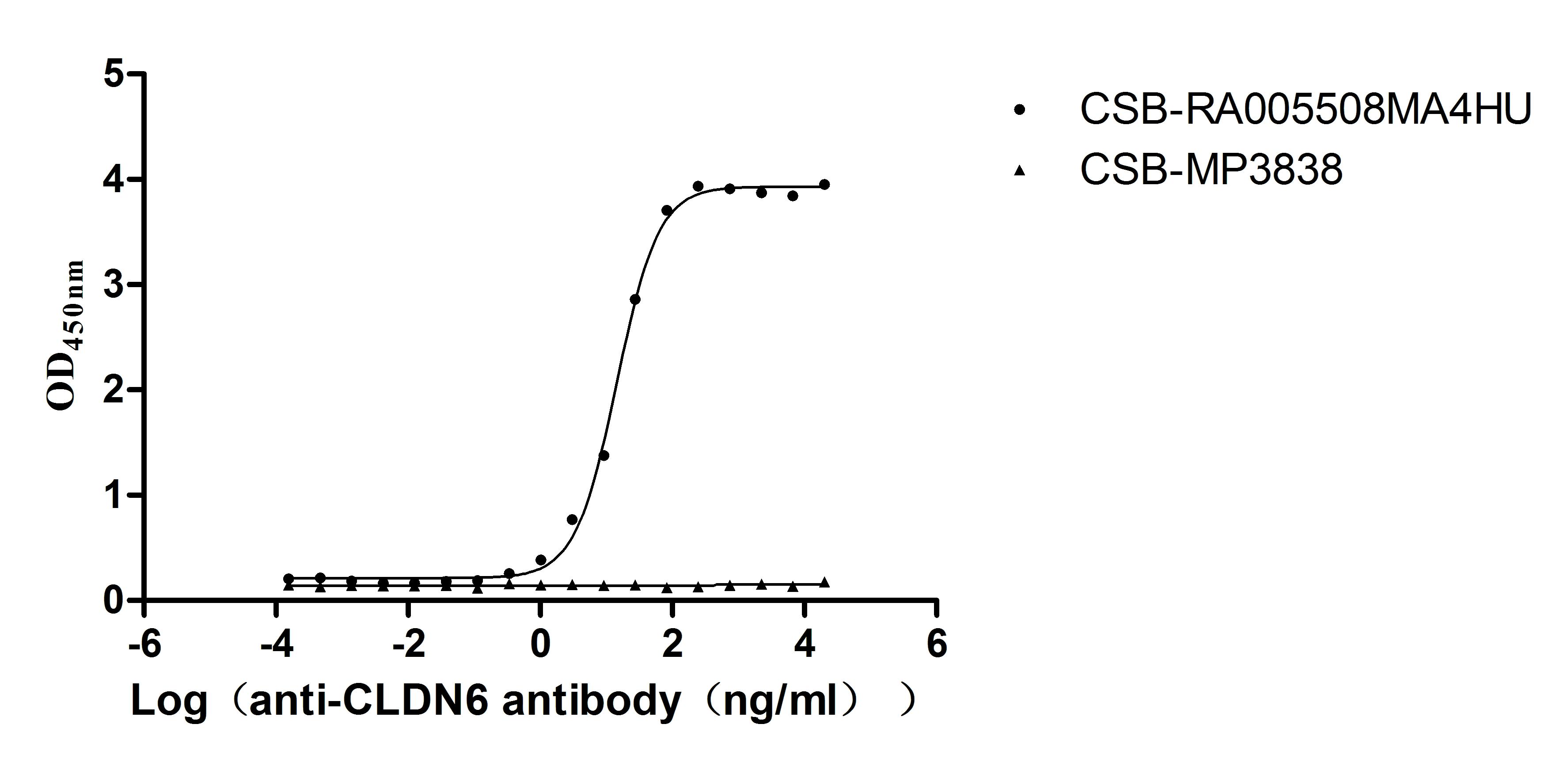
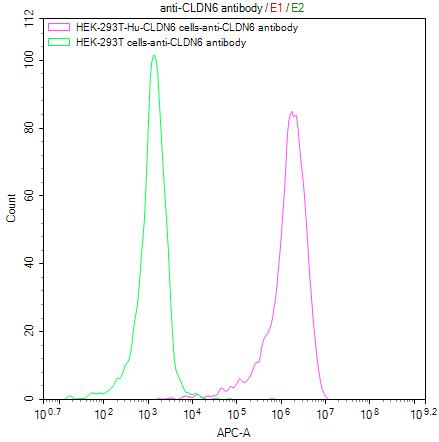
Validation data demonstrates robust performance in functional ELISA, where the antibody binds immobilized human CLDN6 protein with an EC50 of 12.95–16.18 ng/mL, confirming high-affinity target recognition. Flow cytometry experiments using HEK-293T cells stably transfected with human CLDN6 show clear discrimination between CLDN6-expressing and untransfected populations at a working concentration of 2 µg per million cells, with recommended dilutions ranging from 1:50 to 1:200.
The mouse IgG2a isotype and non-conjugated format provide flexibility for researchers to select detection systems suited to their specific experimental designs. This antibody serves as a reliable tool for investigators exploring tight junction biology, stem cell characterization, and signal transduction mechanisms.
There are currently no reviews for this product.





