
Call us
301-363-4651 (Available 9 a.m. to 5 p.m. CST from Monday to Friday)

| Code | CSB-RA194672A0HU |
| Size | US$210 |
| Order now | |
| Image |
|
| Have Questions? | Leave a Message or Start an on-line Chat |
| Application | Recommended Dilution |
|---|---|
| WB | 1:500-1:2000 |
| IHC | 1:50-1:200 |
| FC | 1:50-1:200 |
Cytochrome c serves as an essential component of the mitochondrial electron transport chain and plays a pivotal role in the intrinsic apoptotic pathway. When released from mitochondria into the cytosol, this small heme protein triggers caspase activation, making it a critical marker for studying programmed cell death, mitochondrial dysfunction, and cellular stress responses across diverse research contexts.
This recombinant monoclonal antibody, clone 10C3, offers the reproducibility and consistency that demanding experimental workflows require. Generated against a synthetic peptide derived from human cytochrome c and produced using recombinant technology, this antibody provides sequence-defined specificity with minimal lot-to-lot variation, ensuring your results remain comparable across extended studies.
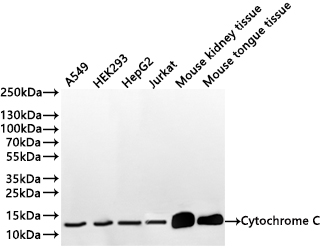
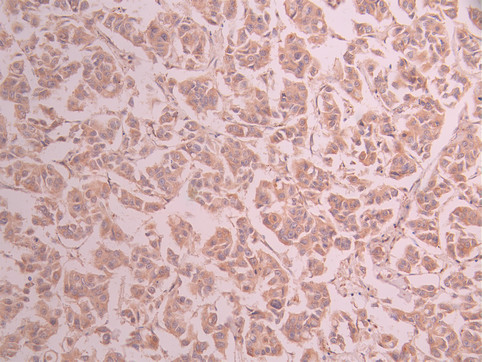
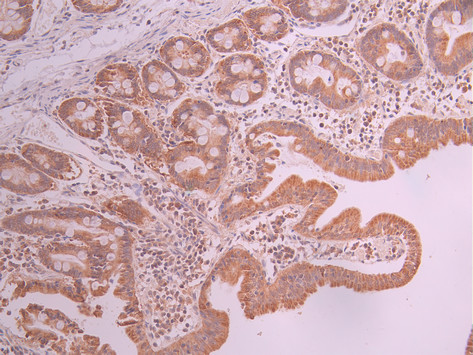
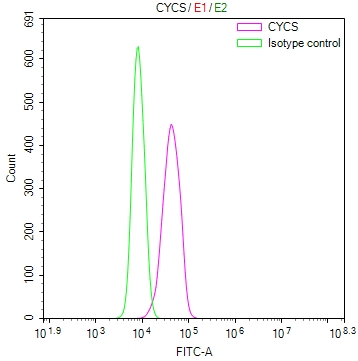
Validation testing demonstrates robust performance across multiple applications. Western blot analysis at 1:1000 dilution reveals a clean 12 kDa band matching the predicted molecular weight, with successful detection confirmed in human cell lines including A549, HEK293, HepG2, and Jurkat, as well as mouse kidney and tongue tissue lysates. This cross-species reactivity between human and mouse samples provides flexibility for researchers working with different model systems. Immunohistochemistry staining at 1:100 dilution shows clear cytoplasmic localization in paraffin-embedded human breast cancer and small intestine tissues using standard citrate buffer antigen retrieval. Flow cytometry validation in HeLa cells demonstrates effective intracellular detection of cytochrome c following fixation and permeabilization.
Whether investigating apoptotic signaling cascades, mitochondrial biology, or cellular metabolism, this affinity-purified rabbit IgG antibody delivers the specificity and application versatility needed for mechanistic studies in cancer research, neurodegenerative disease models, and metabolic investigations.
There are currently no reviews for this product.





