
Call us
301-363-4651 (Available 9 a.m. to 5 p.m. CST from Monday to Friday)

| Code | CSB-RA088784A0HU |
| Size | US$210 |
| Order now | |
| Image |
|
| Have Questions? | Leave a Message or Start an on-line Chat |
| Application | Recommended Dilution |
|---|---|
| WB | 1:500-1:2000 |
| IF | 1:50-1:200 |
| FC | 1:50-1:200 |
EGLN2, also known as PHD1 (prolyl hydroxylase domain-containing protein 1), serves as a critical oxygen sensor in cellular physiology. As one of three prolyl hydroxylases that regulate hypoxia-inducible factor (HIF) stability, EGLN2 hydroxylates specific proline residues on HIF-α subunits under normoxic conditions, targeting them for proteasomal degradation. This regulatory mechanism positions EGLN2 at the center of cellular oxygen sensing pathways, making it a compelling target for researchers investigating hypoxia responses, metabolic adaptation, and tumor microenvironment biology.
This recombinant monoclonal antibody, generated against a synthetic peptide from human EGLN2, offers the reproducibility and consistency that demanding experimental workflows require. Because recombinant production yields a sequence-defined antibody from a single clone, researchers can expect uniform performance across experiments and between lot numbers, eliminating a common source of variability in long-term studies.
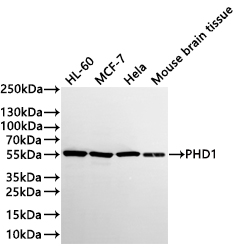
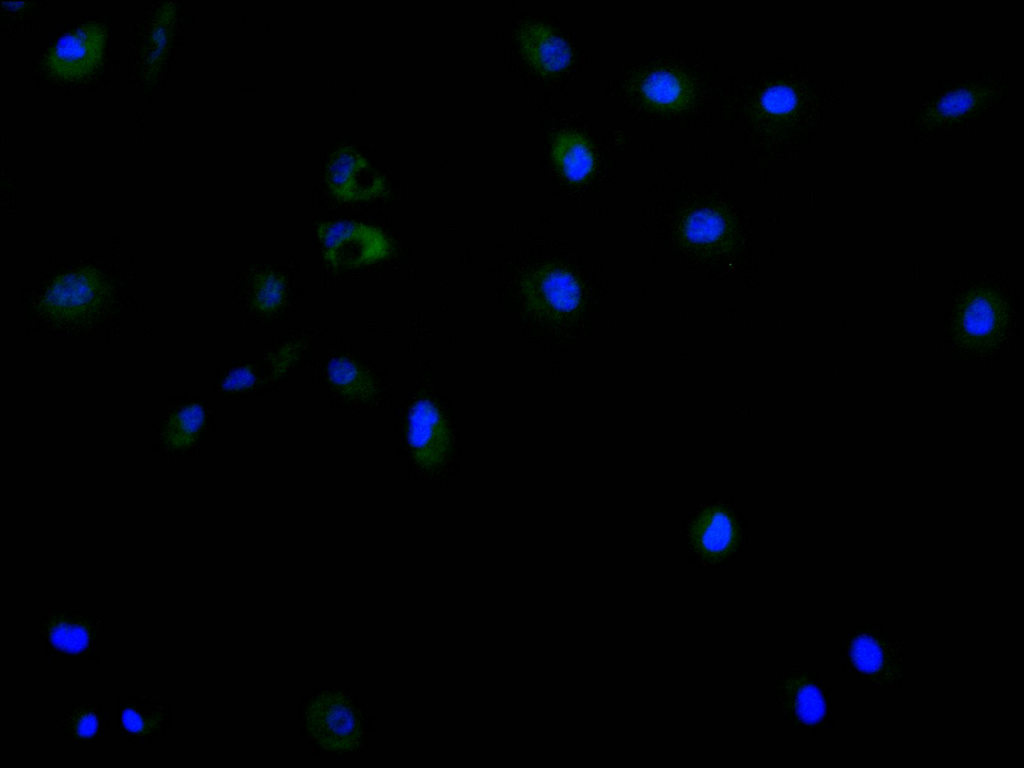
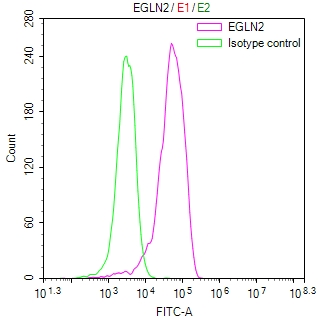
Validation across multiple platforms demonstrates this antibody's experimental flexibility. Western blot analysis confirms specific detection in human cell lines including HL-60, MCF-7, and HeLa, with cross-species reactivity demonstrated in mouse brain tissue. The observed band at approximately 55 kDa runs higher than the predicted 44 kDa molecular weight, likely reflecting post-translational modifications such as glycosylation that are characteristic of the native protein. Immunofluorescence staining in A549 cells reveals clear cytoplasmic localization, while flow cytometry analysis in MCF-7 cells shows distinct positive population shifts compared to isotype controls.
This antibody supports investigations into oxygen-sensing mechanisms, HIF pathway regulation, and the metabolic reprogramming that characterizes cancer progression and ischemic disease models.
There are currently no reviews for this product.





