
Call us
301-363-4651 (Available 9 a.m. to 5 p.m. CST from Monday to Friday)

| Code | CSB-RA158850A0HU |
| Size | US$210 |
| Order now | |
| Image |
|
| Have Questions? | Leave a Message or Start an on-line Chat |
| Application | Recommended Dilution |
|---|---|
| WB | 1:500-1:2000 |
| FC | 1:50-1:200 |
FADD (Fas-associated death domain protein) serves as a critical adaptor molecule in extrinsic apoptotic signaling, bridging death receptors such as Fas and TRAIL receptors to downstream caspase activation cascades. This central role in programmed cell death makes FADD an essential target for researchers investigating apoptosis regulation, immune cell homeostasis, and the mechanisms by which cancer cells evade cell death pathways.
This recombinant monoclonal antibody, generated from clone 6E12 in rabbit host, offers the reproducibility and consistency that demanding experimental workflows require. Because recombinant antibodies are produced from defined genetic sequences rather than traditional hybridoma methods, researchers benefit from lot-to-lot uniformity that supports reliable data across extended studies and multi-site collaborations. The antibody has been raised against a synthetic peptide derived from human FADD and purified through affinity chromatography to ensure high specificity.
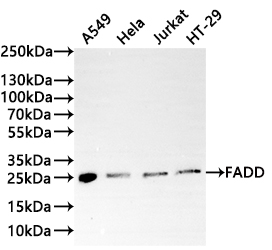
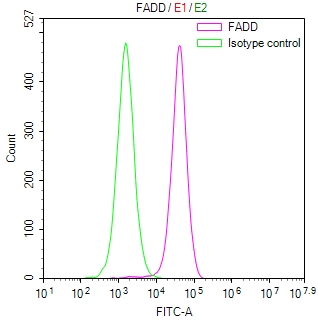
Validation studies demonstrate robust performance across multiple applications. Western blot analysis successfully detects FADD in human cell lines including A549, HeLa, and Jurkat, as well as mouse NIH/3T3 cells, confirming cross-species reactivity with both human and mouse samples. The observed band at approximately 25 kDa runs slightly higher than the predicted 23 kDa molecular weight, a shift commonly attributed to post-translational modifications. Flow cytometry validation in HepG2 cells shows clear positive signal separation from isotype controls, supporting intracellular detection applications.
With validated performance in Western blot, flow cytometry, and ELISA formats, this antibody provides flexibility for researchers studying death receptor signaling, tumor immunology, or therapeutic strategies targeting apoptotic pathways.
There are currently no reviews for this product.





