
Call us
301-363-4651 (Available 9 a.m. to 5 p.m. CST from Monday to Friday)

| Code | CSB-RA029525A0HU |
| Size | US$210 |
| Order now | |
| Image |
|
| Have Questions? | Leave a Message or Start an on-line Chat |
| Application | Recommended Dilution |
|---|---|
| FC | 1:50-1:200 |
Farnesyl pyrophosphate synthase (FDPS) occupies a central position in the mevalonate pathway, catalyzing the synthesis of farnesyl pyrophosphate—a critical precursor for cholesterol biosynthesis, protein prenylation, and the production of ubiquinone and dolichol. This enzymatic hub influences diverse cellular processes from membrane integrity to post-translational modification of signaling proteins, making it a compelling target in cancer metabolism, cardiovascular disease research, and studies of cellular signaling networks. FDPS has also gained attention as the molecular target of nitrogen-containing bisphosphonates, linking it to bone metabolism and immunomodulation research.
This recombinant monoclonal antibody, clone 12H4, offers the reproducibility and sequence-defined consistency that demanding experimental workflows require. Produced in rabbit and raised against a synthetic peptide derived from human FDPS, the recombinant format ensures that researchers can expect uniform performance across experiments and over time—eliminating the lot-to-lot variability that can complicate longitudinal studies or multi-site collaborations.
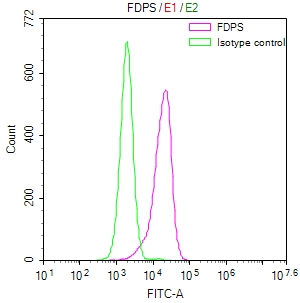
Validated for flow cytometry applications, this antibody has demonstrated clear detection of FDPS in HepG2 human hepatocellular carcinoma cells. Intracellular staining following formaldehyde fixation and Triton X-100 permeabilization produced a distinct positive shift compared to isotype control, confirming specific recognition of the target protein. Recommended dilutions for flow cytometry range from 1:50 to 1:200, providing flexibility to optimize signal intensity for different experimental conditions. The antibody is also validated for ELISA applications.
Supplied in a glycerol-containing buffer optimized for long-term stability, this unconjugated antibody pairs readily with researcher-selected secondary detection systems, supporting integration into established protocols across metabolic research, oncology studies, and cardiovascular investigations.
There are currently no reviews for this product.





