IMPDH2 Recombinant Monoclonal Antibody

Code CSB-RA210986A0HU
Size US$210
Order now
Image
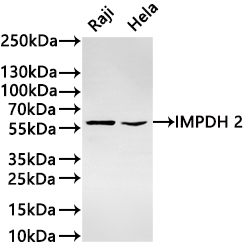
  • Western Blot
    Positive WB detected in: Raji whole cell lysate(30µg),Hela whole cell lysate(30µg)
    All lanes: IMPDH 2 antibody at 1:1000
    Secondary
    Goat polyclonal to rabbit IgG at 1/40000 dilution
    Predicted band size: 56 kDa
    Observed band size: 56 kDa
    Exposure time:2min
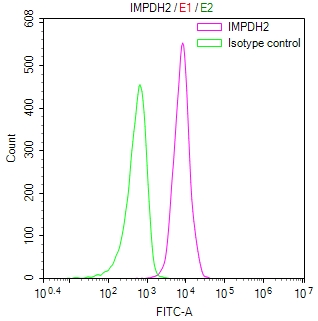
  • Overlay Peak curve showing jurkat cells stained with CSB-RA210986A0HU (red line) at 1:100. The cells were fixed in 4% formaldehyde and permeated by 0.2% TritonX-100 for 10min. Then 10% normal goat serum to block non-specific protein-protein interactions followed by the antibody (1ug/1*106cells) for 45min at 4℃. The secondary antibody used was FITC-conjugated goat anti-rabbit IgG (H+L) at 1/200 dilution for 35min at 4℃.Control antibody (green line) was Rabbit IgG (1ug/1*106cells) used under the same conditions. Acquisition of >10,000 events was performed.
Have Questions? Leave a Message or Start an on-line Chat

Product Details

Uniprot No.
Target Names
Alternative Names
IMDH2_HUMAN antibody; IMP (inosine monophosphate) dehydrogenase 2 antibody; IMP dehydrogenase 2 antibody; IMP oxireductase 2 antibody; IMPD 2 antibody; IMPD2 antibody; IMPDH 2 antibody; IMPDH II antibody; IMPDH-II antibody; Impdh2 antibody; Inosine 5' monophosphate dehydrogenase 2 antibody; Inosine 5' phosphate dehydrogenase 2 antibody; Inosine monophosphate dehydrogenase type II antibody; Inosine-5''-monophosphate dehydrogenase 2 antibody
Species Reactivity
Human
Immunogen
A synthesized peptide derived from human IMPDH2
Immunogen Species
Homo sapiens (Human)
Conjugate
Non-conjugated
Clonality
Monoclonal
Isotype
Rabbit IgG
Clone No.
4F6
Purification Method
Affinity-chromatography
Concentration
It differs from different batches. Please contact us to confirm it.
Buffer
Rabbit IgG in 10mM phosphate buffered saline , pH 7.4, 150mM sodium chloride, 0.05% BSA, 0.02% sodium azide and 50% glycerol.
Form
Liquid
Tested Applications
ELISA, WB, FC
Recommended Dilution
Application Recommended Dilution
WB 1:500-1:2000
FC 1:50-1:200
Troubleshooting and FAQs
Storage
Upon receipt, store at -20°C or -80°C. Avoid repeated freeze.
Lead Time
Basically, we can dispatch the products out in 1-3 working days after receiving your orders. Delivery time maybe differs from different purchasing way or location, please kindly consult your local distributors for specific delivery time.
Description

IMPDH2 (inosine-5'-monophosphate dehydrogenase 2) catalyzes the rate-limiting step in de novo guanine nucleotide biosynthesis, converting IMP to XMP. This metabolic checkpoint is particularly significant in rapidly proliferating cells, including activated lymphocytes and tumor cells, which depend heavily on the de novo pathway rather than salvage mechanisms. IMPDH2 has consequently emerged as a validated therapeutic target for immunosuppression and cancer research, with its expression levels and activity serving as important biomarkers in studies of cellular proliferation and metabolic reprogramming.

This recombinant monoclonal antibody (clone 4F6) offers the reproducibility essential for longitudinal studies and multi-site collaborations. Generated in rabbit and raised against a synthetic peptide derived from human IMPDH2, the antibody's sequence-defined nature eliminates the lot-to-lot variability that can compromise experimental consistency. Affinity chromatography purification ensures high specificity for your target.

Validation studies confirm reliable performance across multiple applications. In western blot analysis, the antibody detects a band at the predicted molecular weight of 56 kDa in both Raji and HeLa whole cell lysates, demonstrating consistent recognition across different human cell types at dilutions of 1:500–1:2000. Flow cytometry validation using Jurkat cells shows clear separation between specific staining and isotype control, enabling intracellular detection of IMPDH2 at dilutions of 1:50–1:200. ELISA compatibility provides additional flexibility for quantitative assessments.

Whether investigating purine metabolism in cancer biology, evaluating immunosuppressive drug mechanisms, or characterizing metabolic dependencies in proliferating cell populations, this antibody delivers the technical consistency your research demands.

Usage
For Research Use Only. Not for use in diagnostic or therapeutic procedures.

Customer Reviews and Q&A

 Customer Reviews

There are currently no reviews for this product.

Submit a Review here

Target Background

Function
Catalyzes the conversion of inosine 5'-phosphate (IMP) to xanthosine 5'-phosphate (XMP), the first committed and rate-limiting step in the de novo synthesis of guanine nucleotides, and therefore plays an important role in the regulation of cell growth. Could also have a single-stranded nucleic acid-binding activity and could play a role in RNA and/or DNA metabolism. It may also have a role in the development of malignancy and the growth progression of some tumors.
Gene References into Functions
  1. Our study demonstrates IMPDH2 may be served as an independent prognostic biomarker for NPC patients, in which high IMPDH expression suggests poor prognosis of NPC patients. PMID: 28389646
  2. inosine-5'-monophosphate dehydrogenase 2 (IMPDH2) is an intracellular target of the PPIA-Sanglifehrin A binary complex. PMID: 28076787
  3. Rod and ring formation might be an adaptive homeostatic mechanism, allowing IMPDH to sense changes in the one-carbon folate pathway. PMID: 27343244
  4. Taking together, these results indicate that natural product myricetin exhibits potent anti-leukemia activity by interfering with purine nucleotides biosynthetic pathway through the suppression of hIMPDH1/2 catalytic activity. PMID: 27378425
  5. The findings suggest that overexpressed IMPDH2 can be used as a biomarker for kidney and bladder cancer diagnosis and is a potential therapeutic target for the diseases PMID: 25465060
  6. IMPDH2 is directly involved in the development of chemoresistance and radioresistance in osteosarcoma cells. PMID: 25392102
  7. Compared with non-cancerous prostate tissues, IMPDH2 mRNA and protein expression levels were both significantly upregulated in prostate cancer tissues. PMID: 24659377
  8. the localization of IMPDH2 inside the nucleus of human cells as well as the ultrastructure of R&R inclusions PMID: 24980853
  9. Rods and rings (RR) are protein assemblies composed of CTPS1 and IMPDH2. Glutamine deprivation initiates reversible assembly of mammalian rods and rings. PMID: 24477477
  10. An insight to the dynamics of conserved water-mediated salt bridge interaction and interdomain recognition in hIMPDH isoforms. PMID: 22928911
  11. Role of salt bridge dynamics in inter domain recognition of human IMPDH isoforms: an insight to inhibitor topology for isoform-II. PMID: 22066532
  12. This ethnic-related data might contribute to a better understanding of the variability in clinical outcome and/or dose adjustments of drugs that are IMPDH inhibitors such as mycophenolic acid. PMID: 21181270
  13. the 3757C allele was associated with higher lymphocyte counts and a reduced incidence of lymphopenia among kidney allograft recipients PMID: 21996196
  14. Anti-IMPDH2 may cause difficulties in interpretation of immunofluorescence patterns in routine autoantibody testing. PMID: 22029192
  15. IMPDHII plays an important role in the negative regulation of TLR2 signaling by modulating PI3K activity. PMID: 21460227
  16. in the absence of ligand the mobilities of "flap" and "loop" regions of IMPDH-II (1B3O) structures are mostly controlled by the four (W 1, W 2, W 3, and W 4) conserved water molecular centers and their dynamics PMID: 20135634
  17. resequenced IMPDH1 and IMPDH2 using DNA from 288 individuals from three ethnic groups and performed functional genomic studies of the sequence variants observed; identfied 25 SNPs, 24 novel, in IMPDH2 PMID: 20718729
  18. IMPDH2 is directly involved in the development of chemoresistance in osteosarcoma cells PMID: 20808934
  19. IMPDH2 genetic polymorphism was investigated in 96 individuals of Caucasian origin. PMID: 19810816
  20. Pharmacogenetic analysis of IMPDH II may represent a novel approach to mycophenolate mofetil therapeutic monitoring. PMID: 15621150
  21. Nine genetic variants were identified in the IMPDH2 gene, with frequencies of the rarer alleles ranging from 0.5 to 10.2%. PMID: 17496727
  22. IMPDH2 is a marker gene useful for stratifying osteosarcoma patients into low- and high-risk groups and predicting therapy outcome. PMID: 17660802
  23. The effect of diabetes mellitus on mycophenolic acid pharmacokinetics and catalytic activity of inosine monophosphate dehydrogenase 2 was investigated in maintenance kidney transplant recipients. PMID: 18043470
  24. The synthesis and activity of several novel inhibitors of IMPDH2 are reported. PMID: 18583139
  25. Analysis of in vivo C-MYC interactions with TS, IMPDH2 and PRPS2 genes confirmed that they are direct C-MYC targets. PMID: 18677108
  26. The expression of IMPDH2 in tumor tissue was significantly higher in patients with colorectal cancer than that in healthy subjects. PMID: 19597826
  27. the IMPDH type II 3757T > C polymorphism is associated with an increased IMPDH activity in MMF-treated renal transplant patients PMID: 19617864

Show More

Hide All

Subcellular Location
Cytoplasm. Nucleus. Cytoplasm, cytosol.
Protein Families
IMPDH/GMPR family
Tissue Specificity
IMPDH1 is the main species in normal leukocytes and IMPDH2 predominates over IMPDH1 in the tumor.
Database Links

HGNC: 6053

OMIM: 146691

KEGG: hsa:3615

STRING: 9606.ENSP00000321584

UniGene: Hs.654400

icon of phone
Call us
301-363-4651 (Available 9 a.m. to 5 p.m. CST from Monday to Friday)

icon of address
Address
No. 269, Shendun 5th Road, Donghu Hi-Tech Development Area, Hubei Province, 430206, P.R.China
icon of social media
Join us with

Subscribe newsletter

Leave a message

* To protect against spam, please pass the CAPTCHA test below.
CAPTCHA verification
© 2007-2026 CUSABIO TECHNOLOGY LLC All rights reserved. 鄂ICP备15011166号-1
Place an order now

I. Product details

*
*
*
*

II. Contact details

*
*

III. Ship To

*
*
*
*
*
*
*

IV. Bill To

*
*
*
*
*
*
*
*


