MT-CO2 Recombinant Monoclonal Antibody

Code CSB-RA963831A0HU
Size US$210
Order now
Image
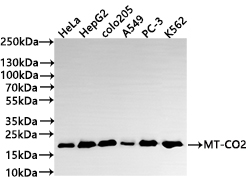
  • Western Blot
    Positive WB detected in: HeLa whole cell lysate(30µg), HepG2 whole cell lysate(30µg), COLO205 whole cell lysate(30µg), A549 whole cell lysate, PC-3 whole cell lysate(30µg), K562 whole cell lysate(30µg)
    All lanes: MT-CO2 antibody at 1:1000
    Secondary
    Goat polyclonal to rabbit IgG at 1/50000 dilution
    Predicted band size: 26 kDa
    Observed band size: 21 kDa
    Exposure time: 1min
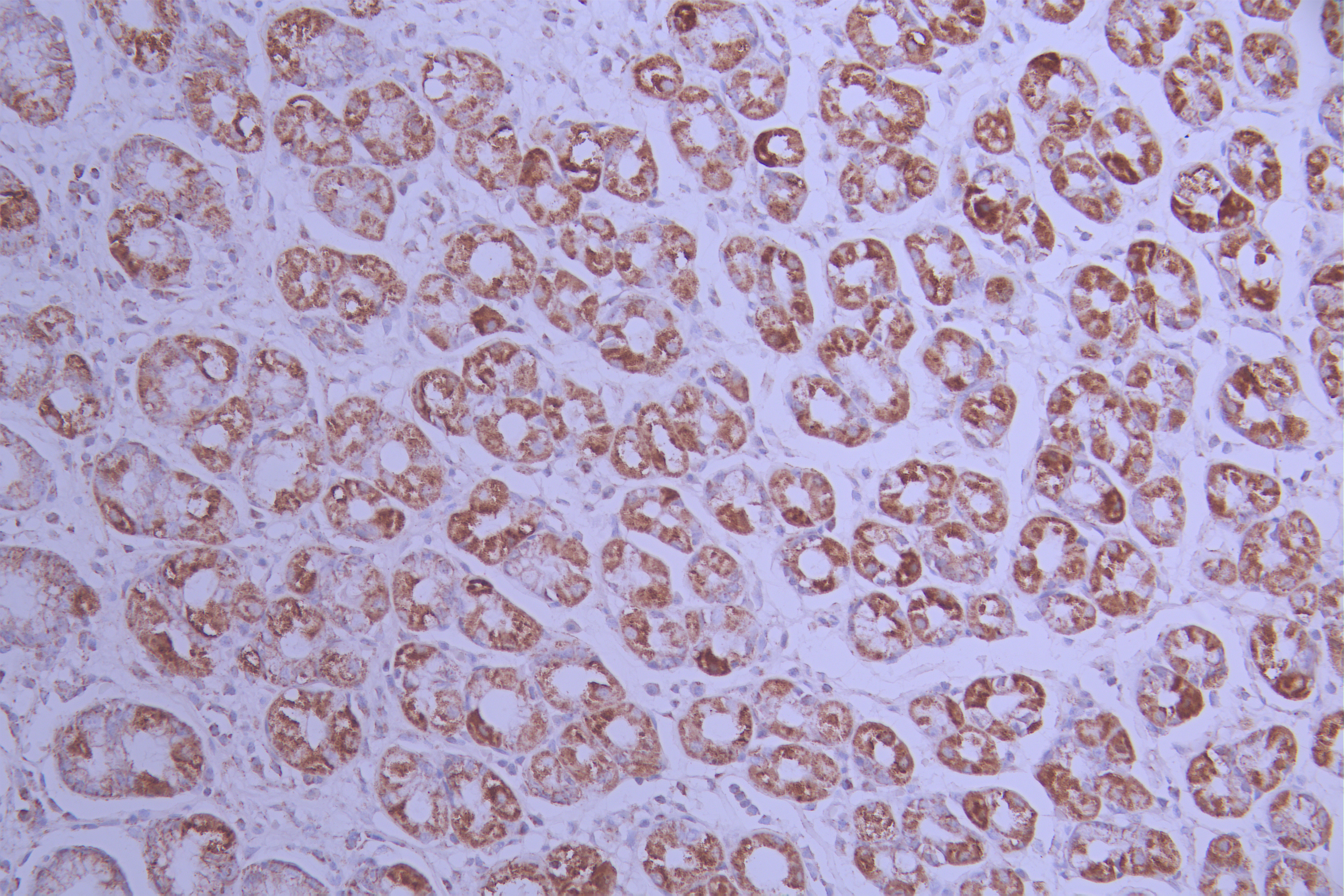
  • IHC image of CSB-RA963831A0HU diluted at 1:100 and staining in paraffin-embedded human stomach tissue performed on a Leica BondTM system. After dewaxing and hydration, antigen retrieval was mediated by high pressure in a citrate buffer (pH 6.0). Section was blocked with 10% normal goat serum 30min at RT. Then primary antibody (1% BSA) was incubated at 4°C overnight. The primary is detected by a Goat anti-rabbit polymer IgG labeled by HRP and visualized using 0.05% DAB.
Have Questions? Leave a Message or Start an on-line Chat

Product Details

Uniprot No.
Target Names
Alternative Names
COII antibody; COX 2 antibody; COX II antibody; COX2 antibody; COX2_HUMAN antibody; COXII antibody; Cytochrome c oxidase II antibody; Cytochrome c oxidase polypeptide II antibody; Cytochrome c oxidase subunit 2 antibody; MT CO2 antibody; MT-CO2 antibody; MTCO2 antibody
Species Reactivity
Human
Immunogen
A synthesized peptide derived from human MT-CO2
Immunogen Species
Homo sapiens (Human)
Conjugate
Non-conjugated
Clonality
Monoclonal
Isotype
Rabbit IgG
Clone No.
2D5
Purification Method
Affinity-chromatography
Concentration
It differs from different batches. Please contact us to confirm it.
Buffer
Rabbit IgG in 10mM phosphate buffered saline , pH 7.4, 150mM sodium chloride, 0.05% BSA, 0.02% sodium azide and 50% glycerol.
Form
Liquid
Tested Applications
ELISA, WB, IHC
Recommended Dilution
Application Recommended Dilution
WB 1:500-1:2000
IHC 1:50-1:200
Troubleshooting and FAQs
Storage
Upon receipt, store at -20°C or -80°C. Avoid repeated freeze.
Lead Time
Basically, we can dispatch the products out in 1-3 working days after receiving your orders. Delivery time maybe differs from different purchasing way or location, please kindly consult your local distributors for specific delivery time.
Description

Cytochrome c oxidase subunit 2 (MT-CO2) is a mitochondrially-encoded core component of Complex IV in the electron transport chain, where it plays an essential role in cellular respiration by catalyzing the transfer of electrons from cytochrome c to molecular oxygen. As a key subunit of the terminal enzyme in oxidative phosphorylation, MT-CO2 serves as a valuable marker for mitochondrial function, biogenesis, and respiratory chain integrity, making it particularly relevant to research in metabolic disorders, neurodegeneration, and cancer metabolism.

This recombinant monoclonal antibody, produced from a defined sequence in rabbit host, offers the consistency and reproducibility that demanding experimental workflows require. Unlike traditional hybridoma-derived antibodies, recombinant production ensures lot-to-lot uniformity, giving researchers confidence that results remain comparable across extended studies and collaborative projects.

Validation testing demonstrates reliable performance across multiple applications. In Western blot analysis, the antibody detects MT-CO2 across a diverse panel of human cell lines including HeLa, HepG2, COLO205, A549, PC-3, and K562, with optimal dilutions ranging from 1:500 to 1:2000. The observed band at approximately 21 kDa runs slightly lower than the predicted 26 kDa molecular weight, a common observation for mitochondrial membrane proteins that may reflect post-translational processing or the protein's hydrophobic character affecting gel migration. For immunohistochemistry applications, the antibody has been validated in paraffin-embedded human stomach tissue at dilutions of 1:50 to 1:200, enabling researchers to examine MT-CO2 expression patterns in tissue contexts.

This antibody supports investigations into mitochondrial dysfunction, oxidative stress responses, and metabolic reprogramming in disease states.

Usage
For Research Use Only. Not for use in diagnostic or therapeutic procedures.

Customer Reviews and Q&A

 Customer Reviews

There are currently no reviews for this product.

Submit a Review here

Target Background

Function
Component of the cytochrome c oxidase, the last enzyme in the mitochondrial electron transport chain which drives oxidative phosphorylation. The respiratory chain contains 3 multisubunit complexes succinate dehydrogenase (complex II, CII), ubiquinol-cytochrome c oxidoreductase (cytochrome b-c1 complex, complex III, CIII) and cytochrome c oxidase (complex IV, CIV), that cooperate to transfer electrons derived from NADH and succinate to molecular oxygen, creating an electrochemical gradient over the inner membrane that drives transmembrane transport and the ATP synthase. Cytochrome c oxidase is the component of the respiratory chain that catalyzes the reduction of oxygen to water. Electrons originating from reduced cytochrome c in the intermembrane space (IMS) are transferred via the dinuclear copper A center (CU(A)) of subunit 2 and heme A of subunit 1 to the active site in subunit 1, a binuclear center (BNC) formed by heme A3 and copper B (CU(B)). The BNC reduces molecular oxygen to 2 water molecules using 4 electrons from cytochrome c in the IMS and 4 protons from the mitochondrial matrix.
Gene References into Functions
  1. Study shows that higher COX-2 and ALOX5 expression in colorectal cancer (CRC) tissues was correlated with poorer prognosis in patients with CRC. Also, MiR-216a-3p was shown to directly bind to there 3'-UTR and inversely regulates their protein levels modulating CRC cell proliferation. PMID: 28786533
  2. Data suggest that mutations in MT-CO2 and MT-ND5 can be involved in MIDD (maternally inherited diabetes and deafness); a Tunisian family (mother, daughter, son) with clinical features of MIDD associated with retinopathy exhibit mutations in MT-CO2 (m.8241T>G - p. F219C) and MT-ND5 (m.13276G>A - p. M314V); these two mutations could explain retinopathy in some family members. (MT-ND5 = NADH dehydrogenase subunit 5) PMID: 27422531
  3. Results demonstrates that the presence of high levels of COX-2 is associated with poor prognosis for breast cancer patients and predicts bigger tumor size and lymph node metastasis. [metastasis] PMID: 27999206
  4. results demonstrated that XRCC5 promoted colon cancer growth by cooperating with p300 to regulate COX-2 expression, and suggested that the XRCC5/p300/COX-2 signaling pathway was a potential target in the treatment of colon cancers PMID: 29049411
  5. inhibitory effects of 17-AAG on PGE2 levels in HT-29 colorectal cancer cells were mediated through modulating COX-2 and 15-PGDH expression. PMID: 27075590
  6. The sequencing analysis revealed the presence of 17 variants, mostly causing non-synonymous changes in conserved amino acid residues, typically distributed in the MT-CO2 gene of MUTYH-associated polyposis patients (P < 0.0001), who frequently carried the hot spot m.7763G>A variant. PMID: 26138249
  7. Results find that COA6 associates with COX2 and is crucial for its maturation and complex IV biogenesis. Also, COA6 interacts with the copper chaperone SCO1 which indicates that COA6 is intrinsically involved in the copper delivery process for COX2. PMID: 26160915
  8. Mutational analysis show a novel MTCO2 mutation 8249G>A pathogenic variation in Tunisian patients with mitochondrial myopathy. PMID: 23841600
  9. We also detected in 4 asthenospermic patients a double novels mutations, the first was found in COXII gene (m.8021 G/A) that was absent in normospermic infertile men. PMID: 24931671
  10. The presence of a non-synonymous variation in the COII strongly correlated with poor survival in patients with cytogenetically normal acute myeloid leukemia. PMID: 23826975
  11. Protein modeling revealed loss of function mutations of ND6 and COX-II proteins in malignant vs benign tumors PMID: 24061460
  12. COX-2 expression played an essential role in the proliferation and metastasis of tongue cancer. PMID: 21069476
  13. Novel COII mutations responsible for maternally inherited nonsyndromic hearing loss PMID: 22241583
  14. The apoptotic index of pulmonary vascular endothelial cells was negatively correlated with COXII expression in patients with chronic obstructive pulmonary disease. PMID: 21092633
  15. This protein has been found differentially expressed in thalami from patients with schizophrenia. PMID: 20471030
  16. COX-II is induced in HIV infected apoptotic T-cells. PMID: 19771519
  17. Ageing muscle: clonal expansions of mitochondrial DNA point mutations and deletions cause focal impairment of mitochondrial function. PMID: 12031622
  18. the expression of mitochondria-encoded COXII is HRG-responsive. The levels of ErbB2 expression are decisive for the diverse biological activities of HRG. PMID: 12115729
  19. frequency of occurrence of mtDNA with the COII/tRNA(Lys) intergenic 9-bp deletion polymorphism in patients with myoclonic epilepsy with ragged-red fibers or mitochondrial encephalomyopathy syndrome is higher than that of healthy subjects PMID: 15965049
  20. Mutations in mtDNA-encoded cytochrome c oxidase subunit II genes causing isolated myopathy or severe encephalomyopathy. PMID: 16288875
  21. DNA hypermethylation of the COX-2 gene may be a potential prognostic marker in early stage cervical cancer. PMID: 17578348
  22. a fraction of Sco1 physically associates with the cytochrome c oxidase complex in human muscle mitochondria, suggesting a possible direct relationship between CcO and the regulation of cellular copper homeostasis PMID: 19295170
  23. SCO2 acts upstream of SCO1, and that it is indispensable for CO II synthesis. PMID: 19336478
  24. CoxII can be phosphorylated by EGFR and c-Src, and EGF stimulation reduces Cox activity and cellular ATP, an event that is dependent in large part on EGFR localized to the mitochondria. PMID: 19840943
  25. Observational study of gene-environment interaction and pharmacogenomic / toxicogenomic. (HuGE Navigator) PMID: 12732844

Show More

Hide All

Involvement in disease
Mitochondrial complex IV deficiency (MT-C4D)
Subcellular Location
Mitochondrion inner membrane; Multi-pass membrane protein.
Protein Families
Cytochrome c oxidase subunit 2 family
Database Links

HGNC: 7421

OMIM: 220110

KEGG: hsa:4513

STRING: 9606.ENSP00000354876

icon of phone
Call us
301-363-4651 (Available 9 a.m. to 5 p.m. CST from Monday to Friday)

icon of address
Address
No. 269, Shendun 5th Road, Donghu Hi-Tech Development Area, Hubei Province, 430206, P.R.China
icon of social media
Join us with

Subscribe newsletter

Leave a message

* To protect against spam, please pass the CAPTCHA test below.
CAPTCHA verification
© 2007-2026 CUSABIO TECHNOLOGY LLC All rights reserved. 鄂ICP备15011166号-1
Place an order now

I. Product details

*
*
*
*

II. Contact details

*
*

III. Ship To

*
*
*
*
*
*
*

IV. Bill To

*
*
*
*
*
*
*
*


