
Call us
301-363-4651 (Available 9 a.m. to 5 p.m. CST from Monday to Friday)

| Code | CSB-RA201307A0HU |
| Size | US$210 |
| Order now | |
| Image |
|
| Have Questions? | Leave a Message or Start an on-line Chat |
| Application | Recommended Dilution |
|---|---|
| WB | 1:500-1:5000 |
| IHC | 1:50-1:200 |
PPP1R1B, also known as DARPP-32, serves as a critical integrator of dopaminergic and glutamatergic signaling in the central nervous system. This phosphoprotein functions as a potent inhibitor of protein phosphatase 1 when phosphorylated by protein kinase A, positioning it at the convergence of multiple neurotransmitter pathways. Its enrichment in medium spiny neurons of the striatum makes it an essential marker for studying reward circuitry, addiction mechanisms, and neurodegenerative conditions affecting the basal ganglia.
This recombinant monoclonal antibody, generated against a synthetic peptide from human PPP1R1B, offers the reproducibility and sequence-defined consistency that demanding neurological research requires. Because the antibody is produced from a stable clone rather than traditional hybridoma methods, you can expect uniform performance across experiments and between lot numbers, eliminating a common source of variability in longitudinal studies.
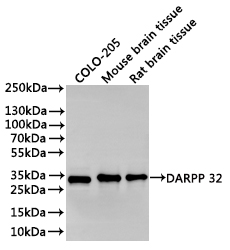
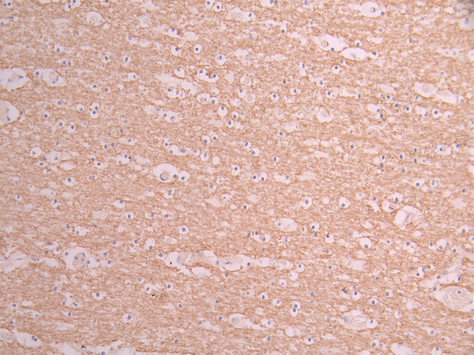
Validation testing demonstrates robust detection across species, with Western blot analysis confirming specific bands in COLO-205 whole cell lysate as well as mouse and rat brain tissue lysates. The observed molecular weight of approximately 32 kDa, higher than the predicted 23 kDa, likely reflects post-translational modifications including phosphorylation events central to DARPP-32's regulatory function. This cross-species reactivity between human and rodent samples supports translational research workflows. Immunohistochemistry validation in paraffin-embedded human brain tissue at 1:100 dilution shows clear staining, with recommended working dilutions ranging from 1:50 to 1:200 depending on your specific tissue preparation and detection system.
This antibody supports investigations into dopamine signaling pathways, striatal function, psychiatric disorders, and Parkinson's disease research where DARPP-32 dysregulation plays a documented role.
There are currently no reviews for this product.





