
Call us
301-363-4651 (Available 9 a.m. to 5 p.m. CST from Monday to Friday)

| Code | CSB-RA927089A0HU |
| Size | US$210 |
| Order now | |
| Image |
|
| Have Questions? | Leave a Message or Start an on-line Chat |
| Application | Recommended Dilution |
|---|---|
| WB | 1:500-1:2000 |
| IHC | 1:50-1:200 |
| FC | 1:50-1:200 |
PSENEN, also known as PEN-2 (Presenilin enhancer protein 2), serves as an essential component of the gamma-secretase complex, a multi-subunit protease responsible for the intramembrane cleavage of numerous type I transmembrane proteins. This processing activity is particularly significant in Alzheimer's disease research, where gamma-secretase mediates the final cleavage step in amyloid precursor protein processing to generate amyloid-beta peptides. Beyond neurodegeneration, PSENEN plays critical roles in Notch signaling pathways that regulate cell fate decisions, making it a target of interest across developmental biology and oncology research.
This recombinant monoclonal antibody, generated from clone 16E3 in rabbit host, offers the reproducibility and consistency that demanding experimental workflows require. Because the antibody sequence is defined and production occurs through recombinant expression, researchers can expect reliable performance across experiments and between lots, eliminating the variability concerns associated with traditional hybridoma-derived antibodies.
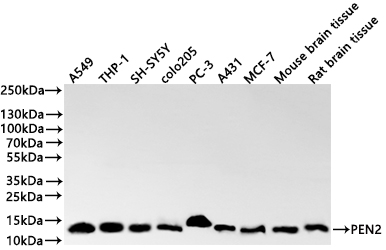
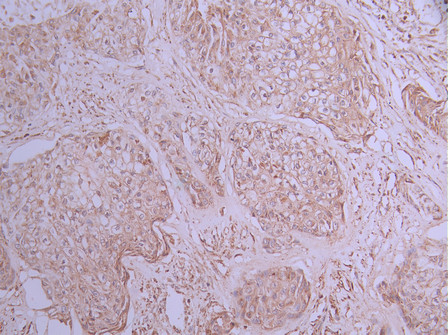
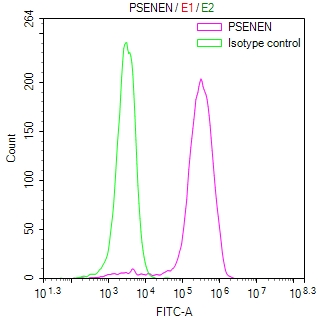
Validation studies demonstrate robust performance across multiple platforms. Western blot analysis detects a clean 12 kDa band matching the predicted molecular weight, confirmed in diverse human cell lines including A549, THP-1, SH-SY5Y, Colo205, PC-3, A431, and MCF-7. Cross-species reactivity extends to mouse and rat brain tissue lysates, supporting translational studies using rodent models. Immunohistochemistry validation in paraffin-embedded human pancreatic cancer tissue shows specific staining, while flow cytometry analysis in MCF-7 cells demonstrates clear population separation from isotype controls.
This antibody supports researchers investigating gamma-secretase biology, neurodegenerative disease mechanisms, Notch pathway regulation, and cancer biology where aberrant gamma-secretase activity contributes to disease progression.
There are currently no reviews for this product.





