
Call us
301-363-4651 (Available 9 a.m. to 5 p.m. CST from Monday to Friday)

| Code | CSB-RA013481A324phHU |
| Size | US$210 |
| Order now | |
| Image |
|
| Have Questions? | Leave a Message or Start an on-line Chat |
| Application | Recommended Dilution |
|---|---|
| IF | 1:20-1:200 |
Tau protein, encoded by the MAPT gene, serves as a critical regulator of microtubule stability in neurons and has become one of the most intensively studied targets in neurodegenerative disease research. Phosphorylation at specific residues, including Serine 324, contributes to tau's pathological transformation into the neurofibrillary tangles characteristic of Alzheimer's disease and related tauopathies. Detecting these site-specific phosphorylation events enables researchers to investigate disease mechanisms, track pathological progression, and evaluate potential therapeutic interventions.
This recombinant monoclonal antibody targets phosphorylated MAPT at Serine 324, offering the reproducibility and sequence-defined consistency that phospho-specific detection demands. Developed using recombinant technology with clone 4E8, this rabbit IgG antibody eliminates the lot-to-lot variability that can compromise longitudinal studies or multi-site collaborations. The defined specificity for the phosphorylated epitope, generated against a synthetic phosphopeptide, provides confidence when distinguishing phosphorylated tau from its unmodified form.
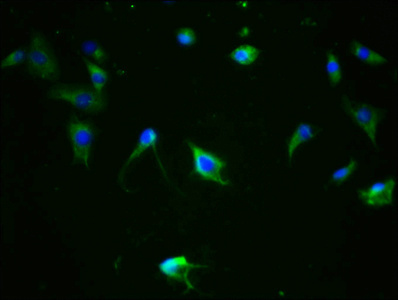
Validation in immunofluorescence applications demonstrates clear cytoplasmic and nuclear detection in SH-SY5Y human neuroblastoma cells, a widely used model for neuronal studies. At a 1:100 dilution, the antibody produces robust signal following standard fixation and permeabilization protocols, with Alexa Fluor 488-conjugated secondary antibody detection. This validation in a human neuronal cell line confirms utility for researchers investigating tau phosphorylation dynamics in disease-relevant cellular contexts.
With reactivity to human MAPT and validated performance in immunofluorescence and ELISA applications, this antibody supports neuroscience researchers studying tau biology, from basic phosphorylation mapping to translational studies exploring tauopathy mechanisms and potential biomarkers.
There are currently no reviews for this product.





