
Call us
301-363-4651 (Available 9 a.m. to 5 p.m. CST from Monday to Friday)

| Code | CSB-RA051685A0HU |
| Size | US$210 |
| Order now | |
| Image |
|
| Have Questions? | Leave a Message or Start an on-line Chat |
| Application | Recommended Dilution |
|---|---|
| WB | 1:500-1:2000 |
| FC | 1:50-1:200 |
SLC1A2, also known as EAAT2 or GLT-1, serves as the predominant glutamate transporter in the central nervous system, responsible for clearing the majority of extracellular glutamate following synaptic transmission. This critical function protects neurons from excitotoxic damage, making SLC1A2 a key focus in neurodegenerative disease research, including studies of amyotrophic lateral sclerosis, Alzheimer's disease, and stroke pathology. Dysregulation of this transporter has been implicated in disrupted glutamatergic signaling and neuronal vulnerability across multiple disease states.
This recombinant monoclonal antibody, clone 28F9, offers researchers the reproducibility essential for longitudinal studies and multi-site collaborations. Because the antibody sequence is defined and production occurs in a controlled recombinant system, you can expect consistent performance across lots, eliminating the variability that often complicates experiments using traditional hybridoma-derived antibodies.
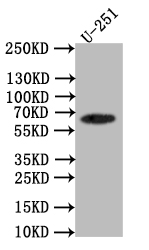
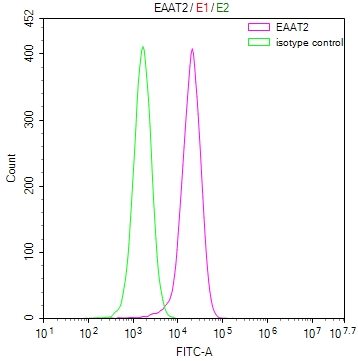
Validation studies demonstrate reliable detection of human SLC1A2 across multiple experimental platforms. Western blot analysis of U251 glioblastoma cell lysate reveals a clean band at the predicted molecular weight of 62 kDa, confirming specificity for the target protein. Flow cytometry validation using MCF-7 cells shows clear separation between antibody-stained and control populations, indicating suitability for surface expression studies. These validated applications, along with ELISA compatibility, provide flexibility whether you are quantifying expression levels, analyzing protein in cell lysates, or characterizing transporter localization on intact cells.
This antibody supports investigations spanning neuroscience, metabolism, and signal transduction research, offering a dependable tool for researchers exploring glutamate homeostasis and its implications in both physiological and pathological contexts.
There are currently no reviews for this product.





