
Call us
301-363-4651 (Available 9 a.m. to 5 p.m. CST from Monday to Friday)

| Code | CSB-RA010429A20me3HU |
| Size | US$210 |
| Order now | |
| Image |
|
| Have Questions? | Leave a Message or Start an on-line Chat |
| Application | Recommended Dilution |
|---|---|
| WB | 1:500-1:5000 |
| ICC | 1:50-1:300 |
Trimethylation of histone H4 at lysine 20 (H4K20me3) represents a critical epigenetic mark associated with heterochromatin formation, transcriptional silencing, and DNA damage response pathways. This modification accumulates at constitutive heterochromatin and plays essential roles in maintaining genome stability, making it a key target for researchers investigating chromatin biology, cell cycle regulation, and cancer epigenetics.
This recombinant monoclonal antibody (clone 1E6) offers the reproducibility and consistency that epigenetic research demands. Generated in rabbit and produced through recombinant technology, it provides sequence-defined specificity with minimal lot-to-lot variation, ensuring your chromatin studies remain comparable across extended experimental timelines. The antibody was raised against a synthetic peptide corresponding to the trimethylated K20 epitope, delivering precise recognition of this specific modification state.
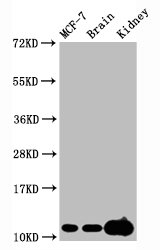
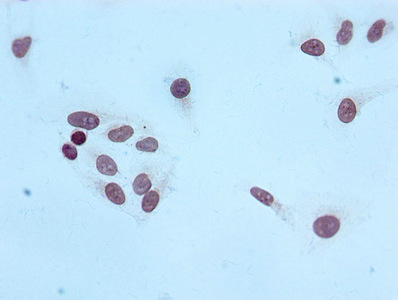
Validation studies demonstrate reliable performance across multiple applications. Western blot analysis confirms detection of the expected 11 kDa band in MCF-7 human breast cancer cells, as well as mouse brain and kidney tissues, indicating utility for cross-species reactivity studies. The observed molecular weight aligns precisely with predicted values, reflecting the compact nature of core histones. Immunocytochemistry validation in HeLa cells further establishes this antibody's suitability for visualizing H4K20me3 distribution patterns within cellular contexts.
Supplied in a glycerol-containing buffer for optimal stability, this affinity-purified antibody supports flexible experimental design across ELISA, western blotting, and immunocytochemistry workflows. For researchers exploring epigenetic mechanisms, nuclear signaling pathways, or chromatin-based disease processes, this antibody provides a dependable tool for interrogating one of the most functionally significant histone modifications in mammalian cells.
There are currently no reviews for this product.





