
Call us
301-363-4651 (Available 9 a.m. to 5 p.m. CST from Monday to Friday)

| Code | CSB-E08054m-IS |
| Size | 96T,5×96T,10×96T |
| Price | Request a Quote |
| Trial Size |
24T ELISA Kit Trial Size (Only USD$150/ kit) * Sample kit cost can be deducted as a $30 credit for each 96-assay kit of the same analyte and brand you subsequently purchase within six months until depleted. More details >> Interested in a trial size? Please leave a message below.
|
| Have Questions? | Leave a Message or Start an on-line Chat |
Intra-assay Precision (Precision within an assay): CV%<8% | ||||||
Three samples of known concentration were tested twenty times on one plate to assess. | ||||||
Inter-assay Precision (Precision between assays): CV%<10% | ||||||
Three samples of known concentration were tested in twenty assays to assess. | ||||||
To assess the linearity of the assay, samples were spiked with high concentrations of mouse IL-1β in various matrices and diluted with the Sample Diluent to produce samples with values within the dynamic range of the assay. | ||||||
| Sample | Serum(n=4) | ||||
1:1 | Average % | 103 | ||||
Range % | 99-109 | |||||
1:2 | Average % | 97 | ||||
Range % | 91-104 | |||||
1:4 | Average % | 98 | ||||
Range % | 93-103 | |||||
1:8 | Average % | 93 | ||||
Range % | 86-99 | |||||
The recovery of mouse IL-1β spiked to levels throughout the range of the assay in various matrices was evaluated. Samples were diluted prior to assay as directed in the Sample Preparation section. | ||||||
Sample Type | Average % Recovery | Range | ||||
Serum (n=5) | 89 | 84-95 | ||||
EDTA plasma (n=4) | 97 | 92-102 | ||||
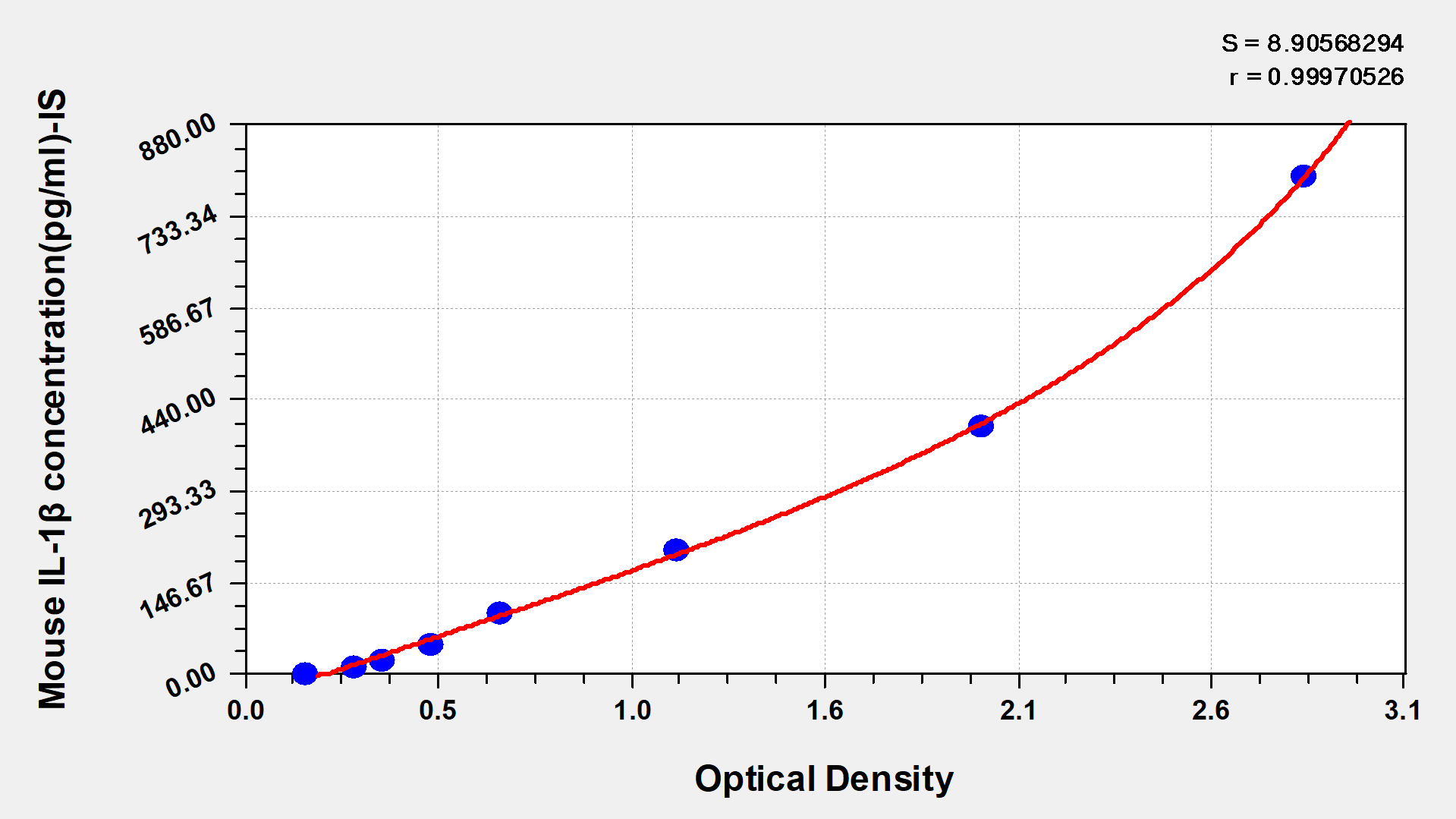
These standard curves are provided for demonstration only. A standard curve should be generated for each set of samples assayed. | |||||||
| |||||||
pg/ml | OD1 | OD2 | Average | Corrected | |||
800 | 2.928 | 2.734 | 2.831 | 2.652 | |||
400 | 1.978 | 1.967 | 1.973 | 1.794 | |||
200 | 1.198 | 1.128 | 1.163 | 0.984 | |||
100 | 0.684 | 0.699 | 0.692 | 0.513 | |||
50 | 0.504 | 0.521 | 0.513 | 0.334 | |||
25 | 0.392 | 0.373 | 0.383 | 0.204 | |||
12.5 | 0.315 | 0.298 | 0.306 | 0.128 | |||
0 | 0.183 | 0.175 | 0.179 |
| |||
This kit provides quantitative measurement of interleukin-1β (IL-1β) in mouse samples, supporting research into innate immune activation, inflammasome signaling, and pyroptic inflammatory responses. Because IL-1β is often measured across both systemic and local tissue compartments to track NLRP3 inflammasome-driven inflammation, the kit is designed to accommodate diverse sample contexts within a single assay platform.
Detection Range: The 12.5–800 pg/ml range spans the concentrations typically observed in mouse serum and plasma during LPS challenge, sterile injury, or infection models, where circulating IL-1β can rise from near-undetectable baseline levels to hundreds of pg/ml. Most stimulated samples can be run neat or with minimal dilution, simplifying assay planning.
Sensitivity: At 3.125 pg/ml, the kit detects the low basal IL-1β levels present in unstimulated controls, naïve serum, or early time points following inflammasome priming—conditions where IL-1β concentrations often fall below 15 pg/ml.
Sample Compatibility: Validation across serum, plasma, tissue homogenates, and cell culture supernatants enables researchers to correlate systemic IL-1β levels with local tissue production and in vitro BMDM or dendritic cell stimulation data within a single study.
Assay Efficiency: Requiring only 50–100 µl and 1–5 hours, the protocol accommodates limited-volume samples from retro-orbital bleeds or small tissue biopsies while supporting same-day results across multi-group kinetic experiments.
This kit is directly applicable to studies of sepsis modeling, NLRP3 inflammasome activation, and colitis-associated mucosal inflammation.
There are currently no reviews for this product.





