
Call us
301-363-4651 (Available 9 a.m. to 5 p.m. CST from Monday to Friday)

| Code | CSB-EP334425VEX |
| Abbreviation | Recombinant Vibrio cholerae serotype O1 zot protein |
| MSDS | |
| Size | $388 |
| Order now | |
| Image |
|
| Have Questions? | Leave a Message or Start an on-line Chat |
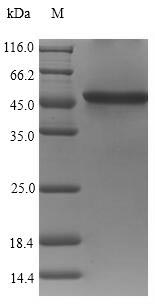
Recombinant Vibrio cholerae serotype O1 Zona occludens toxin (zot) is expressed in E. coli, covering the complete protein from amino acids 1 to 399. The product includes an N-terminal 10xHis tag for straightforward purification and detection. It reaches greater than 90% purity as confirmed by SDS-PAGE, which appears to provide a high-quality preparation for research applications. This product is intended for research use only.
Zona occludens toxin (Zot) is a protein linked to Vibrio cholerae, a bacterium recognized for causing cholera infections. Zot seems to alter tight junctions between cells, affecting intestinal permeability. This protein holds significance in research aimed at understanding bacterial pathogenesis and its effects on epithelial barrier functions. Through studying Zot, researchers may gain insights into how bacterial infections work and how pathogens interact with their hosts.
Potential Applications
Note: The applications listed below are based on what we know about this protein's biological functions, published research, and experience from experts in the field. However, we haven't fully tested all of these applications ourselves yet. We'd recommend running some preliminary tests first to make sure they work for your specific research goals.
Based on the provided information, the recombinant Vibrio cholerae serotype O1 zot is expressed in E. coli, a prokaryotic system that is generally suitable for producing bacterial proteins like zot. As a bacterial toxin originally from Vibrio cholerae, the protein has a higher probability of proper folding in a prokaryotic expression system compared to eukaryotic proteins. The protein is full-length (1-399aa) with an N-terminal 10xHis tag and >90% purity. However, zot is a complex bacterial toxin that requires precise folding for its pore-forming activity and interaction with host cell tight junctions. Since activity is unverified, the protein cannot be assumed to be correctly folded or bioactive without experimental validation of its biological activity.
1. Antibody Development and Immunological Studies
The recombinant zot can serve as an effective immunogen to generate antibodies that recognize linear epitopes, even when the protein is misfolded. The His-tag facilitates purification and screening. However, antibodies may not recognize conformational epitopes of properly folded, active zot toxin. Validation against native zot from V. cholerae is recommended.
2. Protein-Protein Interaction Studies
This application requires caution. While the His-tag enables technical feasibility for pull-down assays, if Zot is misfolded, it may not interact physiologically with true host cell targets (e.g., tight junction proteins). Bacterial toxins require specific conformations for proper target interactions. This application should only be pursued after confirming proper folding and biological activity.
3. Biochemical Characterization
Basic biochemical characterization is feasible, but functional assays require activity validation. Studies should focus on toxin-specific activities (e.g., barrier function disruption). These functional studies should only follow confirmation of proper folding and toxin activity.
4. Structural and Biophysical Analysis
This application is well-suited for assessing the recombinant Vibrio cholerae serotype O1 zot itself. Techniques like circular dichroism spectroscopy, dynamic light scattering, and analytical ultracentrifugation can evaluate the protein's folding state, oligomerization, and stability. These studies are valuable even if the protein is inactive, as they characterize the recombinant product.
Final Recommendation & Action Plan
Given that Zot is a bacterial protein expressed in a prokaryotic system, the probability of proper folding is relatively high. However, recommend first validating the protein's biological activity using appropriate functional assays (e.g., epithelial barrier integrity assays, tight junction disruption tests). Perform biophysical characterization (circular dichroism for secondary structure, size-exclusion chromatography for oligomeric state) to assess folding quality. Antibody development can proceed as the safest application. Avoid functional interaction studies until proper folding and toxin activity are confirmed. For reliable zot research, always include appropriate controls such as known active toxin standards and validate findings with native zot when possible.
There are currently no reviews for this product.
I have the following question for Recombinant Vibrio cholerae serotype O1 Zona occludens toxin (cat#: CSB-EP334425VEX; Lot#: 03663):
Is this toxin thermolabel? Because I want to know if I can clean our lab equipment that we will be using for our experiment (using the toxin) by autoclave? Or what is the best way I can eliminate the toxin safely?
MSIFIHHGAPGSYKTSGALWLRLLPAIKSGRHIITNVRGLNLERMAKYLKMDVSDISIEFIDTDHPDGRLTMARFWHWARKDAFLFIDECGRIWPPRLTVTNLKALDTPPDLVAEDRPESFEVAFDMHRHHGWDICLTTPNIAKVHNMIREAAEIGYRHFNRATVGLGAKFTLTTHDAANSGQMDSHALTRQVKKIPSPIFKMYASTTTGKARDTMAGTALWKDRKILFLFGMVFLMFSYSFYGLHDNPIFTGGNDATIESEQSEPQSKATVGNAVGSKAVAPASFGFCIGRLCVQDGFVTVGDERYRLVDNLDIPYRGLWATGHHIYKDTLTVFFETESGSVPTELFASSYRYKVLPLPDFNHFVVFDTFAAQALWVEVKRGLPIKTENDKKGLNSIF
KEGG: vch:VC1458
STRING: 243277.VC1458





