
Call us
301-363-4651 (Available 9 a.m. to 5 p.m. CST from Monday to Friday)

| Code | CSB-RA005490MA1HU |
| Size | $49.9 |
| Order now | |
| Promotion |

|
| Image |
|
| Have Questions? | Leave a Message or Start an on-line Chat |
| Application | Recommended Dilution |
|---|---|
| ELISA | 1:5000-1:50000 |
Claudin-1 serves as a critical component of tight junction complexes, playing an essential role in maintaining epithelial barrier integrity and regulating paracellular permeability. Beyond its structural function, this transmembrane protein has garnered significant research attention for its involvement in signal transduction pathways and its identification as a senescence-associated epithelial membrane protein. Claudin-1 expression patterns and dysregulation have become increasingly relevant to researchers investigating epithelial biology, barrier function, and cellular aging processes.
This recombinant monoclonal antibody, derived from clone 12A4, offers the reproducibility and consistency that demanding research protocols require. Because the antibody sequence is defined and produced through recombinant technology, you can expect uniform performance across different lots, eliminating the variability concerns that can complicate long-term studies or multi-site collaborations. The human IgG1 isotype format and affinity chromatography purification ensure high purity suitable for sensitive detection methods.
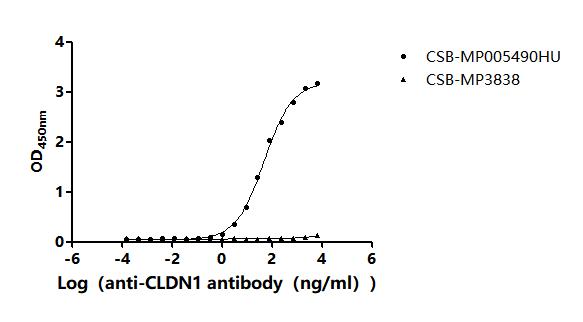
Functional validation through ELISA demonstrates robust binding activity against human Claudin-1, with the antibody achieving an EC50 of 35.03 to 50.71 ng/mL when tested against immobilized recombinant human CLDN1 protein. Specificity was confirmed using virus-like particles as a negative control, showing no non-specific binding. The recommended working dilution range of 1:5000 to 1:50000 for ELISA applications provides flexibility to optimize signal-to-noise ratios based on your specific experimental conditions.
For researchers exploring tight junction biology, epithelial barrier dynamics, or signal transduction mechanisms involving Claudin-1, this antibody provides a reliable tool backed by quantitative binding data and the inherent advantages of recombinant production.
There are currently no reviews for this product.





