
Call us
301-363-4651 (Available 9 a.m. to 5 p.m. CST from Monday to Friday)

| Code | CSB-RA005506MA2HU |
| Size | US$210 |
| Order now | |
| Image |
|
| Have Questions? | Leave a Message or Start an on-line Chat |
| Application | Recommended Dilution |
|---|---|
| FC | 1:50-1:200 |
Claudin-4 is a critical tight junction protein that plays a fundamental role in regulating paracellular permeability and maintaining epithelial barrier integrity. Beyond its structural functions, CLDN4 has garnered significant research attention as the receptor for Clostridium perfringens enterotoxin, making it relevant to studies of bacterial pathogenesis and toxin-mediated disease. The protein's frequent overexpression in various carcinomas has also positioned it as a marker of interest in cancer research, where its altered expression patterns may influence tumor behavior and therapeutic targeting strategies.
This recombinant monoclonal antibody against human CLDN4 offers the reproducibility advantages inherent to recombinant technology. Because the antibody sequence is defined and production occurs through consistent recombinant expression systems, researchers can expect reliable performance across experiments and between lots, eliminating the variability concerns that can complicate long-term studies or multi-site collaborations.
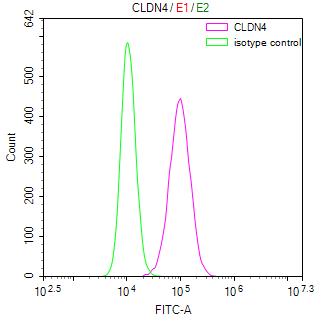
Validation through flow cytometry demonstrates clear detection of CLDN4 on MCF7 breast cancer cells, with surface staining at 1:100 dilution producing distinct signal separation from isotype control. This cell line validation provides a useful positive control reference for researchers establishing their own protocols. The antibody is also validated for ELISA applications, offering flexibility for researchers who need to assess CLDN4 levels through different experimental approaches.
Supplied in a glycerol-based PBS buffer with Proclin 300 preservative, this unconjugated antibody is compatible with standard secondary detection systems. For flow cytometry applications, recommended working dilutions range from 1:50 to 1:200, allowing optimization based on specific experimental conditions and cell types within immunology and epithelial biology research programs.
There are currently no reviews for this product.





