
Call us
301-363-4651 (Available 9 a.m. to 5 p.m. CST from Monday to Friday)

| Code | CSB-RA252392A0HU |
| Size | US$210 |
| Order now | |
| Image |
|
| Have Questions? | Leave a Message or Start an on-line Chat |
| Application | Recommended Dilution |
|---|---|
| WB | 1:500-1:5000 |
| IHC | 1:50-1:200 |
FAS, also known as CD95 or Apo-1, serves as a critical death receptor within the tumor necrosis factor receptor superfamily, orchestrating extrinsic apoptotic signaling upon engagement with FAS ligand. This receptor plays a central role in immune homeostasis, peripheral tolerance, and the elimination of virus-infected or transformed cells, making it a focal point for researchers investigating apoptosis, immune regulation, and cancer biology.
This recombinant monoclonal antibody, clone 2B6, offers the reproducibility and consistency that demanding experimental workflows require. Because recombinant antibodies are produced from defined genetic sequences rather than hybridoma supernatants, researchers benefit from lot-to-lot uniformity that supports longitudinal studies and ensures comparable results across experiments. The rabbit IgG format provides excellent sensitivity while the affinity-chromatography purification yields a reagent ready for immediate use.
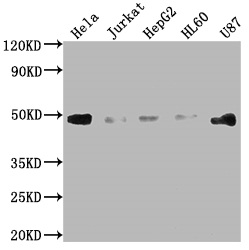
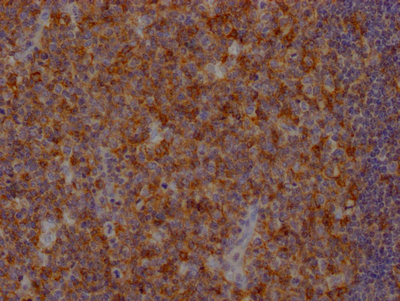
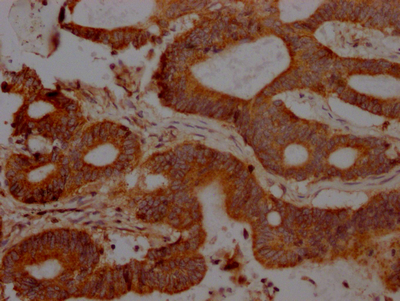
Validation studies demonstrate robust performance across multiple applications. In western blot analysis, this antibody detects FAS protein across a panel of human cell lines including HeLa, Jurkat, HepG2, HL-60, and U87, with an observed band size of approximately 45 kDa. The difference between predicted and observed molecular weight likely reflects post-translational modifications, particularly glycosylation, which is characteristic of this membrane receptor. For immunohistochemistry applications, the antibody has been validated in paraffin-embedded human tonsil tissue and colon cancer specimens using citrate buffer antigen retrieval, producing clear specific staining at 1:100 dilution.
Whether investigating FAS-mediated apoptosis in immune cells, examining death receptor expression in tumor samples, or exploring therapeutic targeting strategies, this antibody provides a reliable tool for cell biology and immunology research programs focused on understanding programmed cell death pathways.
There are currently no reviews for this product.





