
Call us
301-363-4651 (Available 9 a.m. to 5 p.m. CST from Monday to Friday)

| Code | CSB-RA439052A0HU |
| Size | US$210 |
| Order now | |
| Image |
|
| Have Questions? | Leave a Message or Start an on-line Chat |
| Application | Recommended Dilution |
|---|---|
| WB | 1:500-1:5000 |
| IHC | 1:50-1:200 |
HMGB1 (High Mobility Group Box 1) serves as a critical nuclear protein with dual functionality in chromatin architecture and inflammatory signaling. Within the nucleus, HMGB1 facilitates DNA bending and stabilizes nucleosome formation, while its extracellular release acts as a potent damage-associated molecular pattern (DAMP) that triggers innate immune responses. This positions HMGB1 at the intersection of epigenetics, nuclear signaling, and inflammation research, making it a compelling target for studies ranging from gene regulation to sepsis and autoimmune disease mechanisms.
This recombinant monoclonal antibody, generated against a synthetic peptide derived from human HMGB1, offers the reproducibility that demanding experimental workflows require. Because recombinant production yields a sequence-defined antibody from a single clone, researchers can expect consistent performance across experiments and between lot numbers, eliminating the variability that can compromise longitudinal studies or multi-site collaborations.
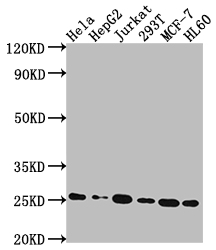
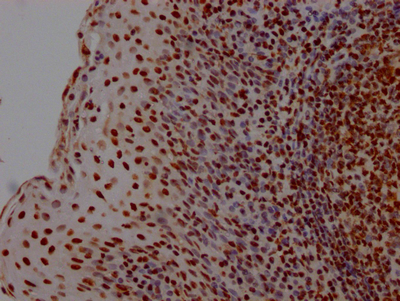
Validation data demonstrates robust performance across multiple platforms. Western blot analysis at 1:2000 dilution reveals a clean 25 kDa band matching the predicted molecular weight, with detection confirmed across six human cell lines including HeLa, HepG2, Jurkat, 293T, MCF-7, and HL60. This broad validation across epithelial, hepatic, lymphoid, and myeloid lineages provides confidence when working with diverse experimental models. Immunohistochemistry staining in paraffin-embedded human tonsil tissue at 1:100 dilution further extends utility to tissue-based investigations, enabling researchers to examine HMGB1 localization and expression patterns in archival specimens.
Whether investigating chromatin dynamics, characterizing inflammatory pathways, or exploring HMGB1's emerging roles in cancer biology, this antibody delivers the specificity and consistency essential for meaningful results.
There are currently no reviews for this product.





