
Call us
301-363-4651 (Available 9 a.m. to 5 p.m. CST from Monday to Friday)

| Code | CSB-RA949793A0HU |
| Size | US$210 |
| Order now | |
| Image |
|
| Have Questions? | Leave a Message or Start an on-line Chat |
| Application | Recommended Dilution |
|---|---|
| WB | 1:500-1:2000 |
| IHC | 1:50-1:200 |
| FC | 1:50-1:200 |
Thioredoxin-interacting protein serves as a critical regulator of cellular redox homeostasis and metabolic signaling, functioning as an endogenous inhibitor of thioredoxin. This multifaceted protein, also known as vitamin D3 up-regulated protein 1, has emerged as a key player in glucose metabolism, oxidative stress responses, and inflammasome activation, making it a compelling target for researchers investigating metabolic disorders, inflammatory diseases, and cancer biology.
This recombinant monoclonal antibody, generated from clone 5D2, offers the reproducibility and consistency that demanding experimental workflows require. Because recombinant antibodies are produced from defined sequences rather than hybridoma-derived sources, researchers benefit from lot-to-lot uniformity that supports reliable data across extended studies and multi-site collaborations.
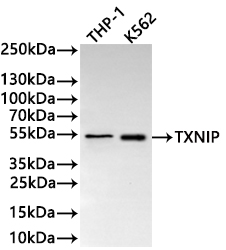
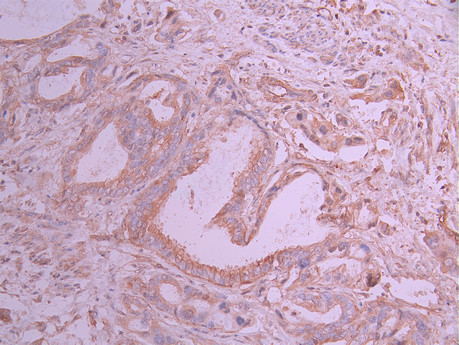
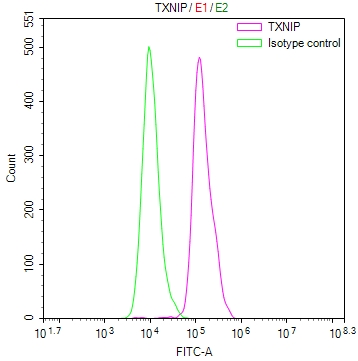
Validation across multiple detection platforms demonstrates this antibody's versatility in your experimental toolkit. Western blot analysis in THP-1 and K562 cell lysates reveals a band at approximately 53 kDa, which runs higher than the predicted 44 kDa molecular weight—a shift commonly attributed to post-translational modifications such as glycosylation or phosphorylation that are characteristic of TXNIP in cellular contexts. Immunohistochemical staining has been validated in paraffin-embedded human cervical cancer tissue, providing clear visualization of TXNIP expression patterns in clinical specimens. Flow cytometry applications have been confirmed using K562 cells, enabling quantitative analysis of intracellular TXNIP levels at the single-cell level.
Whether investigating TXNIP's role in NLRP3 inflammasome activation, exploring its function as a tumor suppressor, or examining its involvement in diabetic complications, this antibody provides a dependable tool for advancing your understanding of redox-sensitive signaling pathways.
There are currently no reviews for this product.





