
Call us
301-363-4651 (Available 9 a.m. to 5 p.m. CST from Monday to Friday)

| Code | CSB-RA802124A0HU |
| Size | US$210 |
| Order now | |
| Image |
|
| Have Questions? | Leave a Message or Start an on-line Chat |
| Application | Recommended Dilution |
|---|---|
| WB | 1:500-1:5000 |
| IHC | 1:50-1:200 |
| IF | 1:20-1:200 |
CD47 serves as a critical "don't eat me" signal on cell surfaces, interacting with signal regulatory protein alpha (SIRPα) on macrophages to inhibit phagocytosis. This pathway has emerged as a compelling target in cancer immunology, where tumor cells frequently overexpress CD47 to evade immune surveillance. Understanding CD47 expression patterns and developing strategies to block this checkpoint has become central to advancing novel immunotherapeutic approaches.
This recombinant monoclonal antibody, clone 4G11, offers researchers the reproducibility essential for longitudinal studies and multi-site collaborations. Because the antibody sequence is defined and production occurs in controlled recombinant systems, you can expect consistent performance across lots, eliminating the variability that can complicate data interpretation when working with traditional hybridoma-derived antibodies.
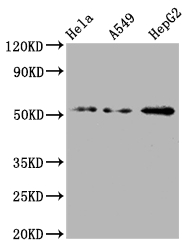
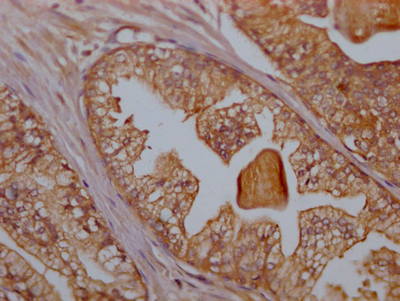
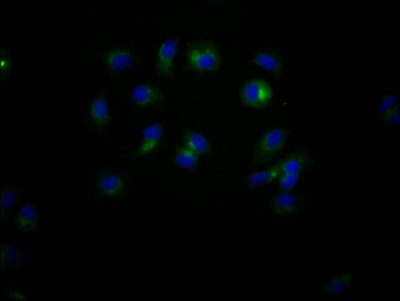
Validation across multiple detection platforms demonstrates genuine workflow flexibility. Western blot analysis at 1:2000 dilution successfully detects CD47 in HeLa, A549, and HepG2 whole cell lysates, with the observed band appearing at approximately 55 kDa rather than the predicted 32-36 kDa. This size difference reflects the extensive glycosylation characteristic of CD47, which contains multiple N-glycosylation sites in its extracellular immunoglobulin domain. Immunohistochemical staining of paraffin-embedded human prostate cancer tissue at 1:100 dilution reveals clear target localization, while immunofluorescence analysis in MCF7 cells at 1:50 dilution enables subcellular visualization of CD47 distribution.
For researchers investigating tumor immune evasion mechanisms, macrophage-mediated phagocytosis, or the broader landscape of immune checkpoint biology, this antibody provides a reliable tool for characterizing CD47 expression across diverse experimental contexts in human samples.
There are currently no reviews for this product.





