
Call us
301-363-4651 (Available 9 a.m. to 5 p.m. CST from Monday to Friday)

| Code | CSB-RA942338A0HU |
| Size | US$210 |
| Order now | |
| Image |
|
| Have Questions? | Leave a Message or Start an on-line Chat |
| Application | Recommended Dilution |
|---|---|
| IHC | 1:50-1:200 |
Estrogen receptor alpha, encoded by the ESR1 gene, serves as a master regulator of estrogen-responsive gene transcription and plays a central role in breast cancer biology, reproductive physiology, and neuroendocrine signaling. As a ligand-activated transcription factor within the nuclear receptor superfamily, ESR1 mediates estrogen's effects on cell proliferation, differentiation, and survival, making it an essential biomarker in both basic research and clinical pathology contexts.
This recombinant monoclonal antibody, generated in rabbit against a synthetic peptide derived from human ER alpha, offers the reproducibility and consistency that demanding experimental workflows require. Because the antibody sequence is defined and production occurs through recombinant expression rather than traditional hybridoma methods, you can expect minimal lot-to-lot variation, ensuring that your staining protocols remain stable across extended studies or multi-site collaborations.
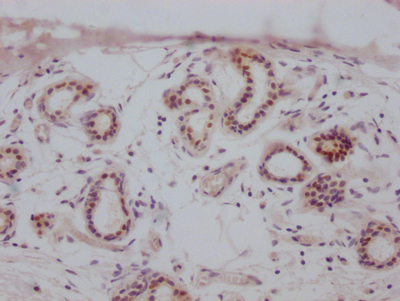
Validation in immunohistochemistry demonstrates clear nuclear localization in paraffin-embedded human breast cancer tissue, with optimal performance at dilutions between 1:50 and 1:200. The validation protocol employed citrate buffer antigen retrieval at pH 6.0 under high pressure, followed by overnight primary antibody incubation at 4°C, providing a reliable starting point for your own optimization. Detection via HRP-conjugated polymer and DAB visualization yielded specific staining consistent with expected ESR1 expression patterns in hormone receptor-positive breast carcinoma.
Whether you are investigating estrogen signaling mechanisms in cancer progression, exploring nuclear receptor biology in neurological contexts, or characterizing hormone receptor status in tumor samples, this antibody provides a dependable tool validated for human tissue applications. Its compatibility with standard IHC workflows and ELISA platforms offers flexibility for researchers working across multiple experimental approaches.
There are currently no reviews for this product.





