
Call us
301-363-4651 (Available 9 a.m. to 5 p.m. CST from Monday to Friday)

| Code | CSB-RA007830A118phHU |
| Size | US$210 |
| Order now | |
| Image |
|
| Have Questions? | Leave a Message or Start an on-line Chat |
| Application | Recommended Dilution |
|---|---|
| IHC | 1:50-1:200 |
Estrogen receptor alpha (ESR1) serves as a master regulator of estrogen-responsive gene transcription, playing a central role in breast tissue development, reproductive physiology, and hormone-driven malignancies. Phosphorylation at serine 118 represents a critical activation event that modulates ESR1 transcriptional activity and can occur through both ligand-dependent and ligand-independent mechanisms, including growth factor signaling pathways. This phosphorylation site has emerged as a key biomarker in breast cancer research, where its status may inform understanding of endocrine therapy response and resistance mechanisms.
This recombinant rabbit monoclonal antibody, clone 4H1, specifically recognizes the phosphorylated serine 118 residue of human ESR1. Developed using recombinant technology, this antibody offers the reproducibility and sequence-defined consistency that phospho-specific detection demands, ensuring reliable results across extended studies where lot-to-lot variation could compromise data interpretation.
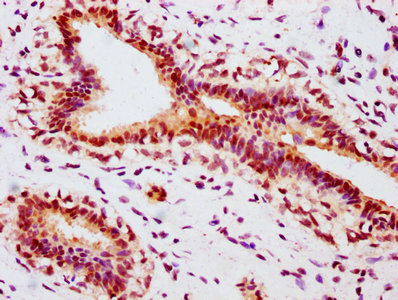
Validation in immunohistochemistry demonstrates clear detection in paraffin-embedded human breast cancer tissue, with optimal staining achieved at dilutions between 1:50 and 1:200 using citrate buffer antigen retrieval. This tissue-based validation confirms the antibody's utility for examining phospho-ESR1 status in clinically relevant sample types. The antibody is also validated for ELISA applications, providing flexibility for researchers requiring quantitative assessment of this phosphorylation event.
Supplied in a glycerol-containing buffer optimized for long-term stability, this phospho-specific antibody supports investigations into estrogen receptor signaling dynamics, hormone receptor status in breast cancer, and the molecular mechanisms underlying endocrine therapy response in signal transduction research.
There are currently no reviews for this product.





