
Call us
301-363-4651 (Available 9 a.m. to 5 p.m. CST from Monday to Friday)

| Code | CSB-RA583933A0HU |
| Size | US$210 |
| Order now | |
| Image |
|
| Have Questions? | Leave a Message or Start an on-line Chat |
| Application | Recommended Dilution |
|---|---|
| WB | 1:500-1:2000 |
| FC | 1:50-1:200 |
LCK, or lymphocyte cell-specific protein-tyrosine kinase, serves as a critical signaling molecule in T cell development and activation. This Src family kinase initiates downstream signaling cascades following T cell receptor engagement, making it essential for adaptive immune responses. Dysregulation of LCK activity has been implicated in various immunological disorders and certain malignancies, positioning it as a significant target for researchers investigating immune cell biology, signal transduction pathways, and potential therapeutic interventions.
This recombinant monoclonal antibody, clone 3D6, offers the reproducibility and consistency that demanding experimental workflows require. Generated against a synthetic peptide derived from human LCK and produced using recombinant technology in rabbit host, this antibody provides sequence-defined specificity that eliminates the lot-to-lot variability often encountered with traditional hybridoma-derived reagents. The affinity-chromatography purification ensures high purity for reliable performance across experiments.
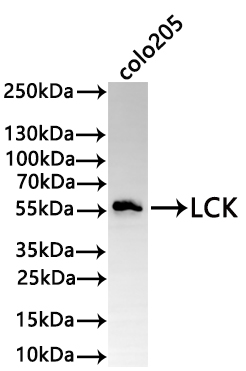
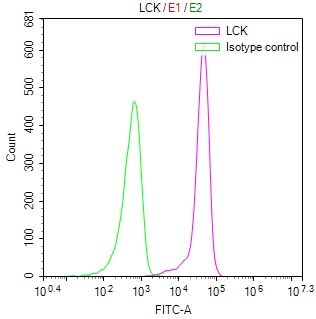
Validation studies demonstrate robust performance in multiple applications. Western blot analysis of COLO205 whole cell lysate detected a band at the predicted molecular weight of 58 kDa, confirming specific target recognition with recommended dilutions between 1:500 and 1:2000. Flow cytometry validation using Jurkat cells, a well-established T cell line, showed clear separation between antibody-stained and control populations at 1:100 dilution, supporting intracellular detection protocols following fixation and permeabilization.
This antibody is particularly well-suited for researchers studying T cell receptor signaling, immunological synapse formation, and lymphocyte development. Its validated performance in both protein detection and single-cell analysis applications provides flexibility for investigators examining LCK expression and function across different experimental contexts in human samples.
There are currently no reviews for this product.





