
Call us
301-363-4651 (Available 9 a.m. to 5 p.m. CST from Monday to Friday)

| Code | CSB-RA151825A0HU |
| Size | US$210 |
| Order now | |
| Image |
|
| Have Questions? | Leave a Message or Start an on-line Chat |
| Application | Recommended Dilution |
|---|---|
| WB | 1:500-1:5000 |
| IF | 1:50-1:200 |
| FC | 1:50-1:200 |
Protein kinase C delta (PRKCD) serves as a critical regulator of cellular signaling pathways, influencing processes ranging from apoptosis and cell cycle progression to immune cell activation. As a member of the novel PKC subfamily, PRKCD responds to diacylglycerol without requiring calcium for activation, positioning it as a key mediator in receptor-initiated signal transduction cascades. Its involvement in diverse physiological and pathological contexts, including cancer biology and inflammatory responses, makes it a compelling target for researchers investigating cellular decision-making mechanisms.
This recombinant monoclonal antibody, generated in rabbit against a synthetic peptide derived from human PRKCD, offers the reproducibility and consistency that demanding experimental workflows require. Because the antibody sequence is defined and production occurs through recombinant expression, researchers can expect minimal lot-to-lot variation, ensuring that results remain comparable across extended studies and collaborative projects.
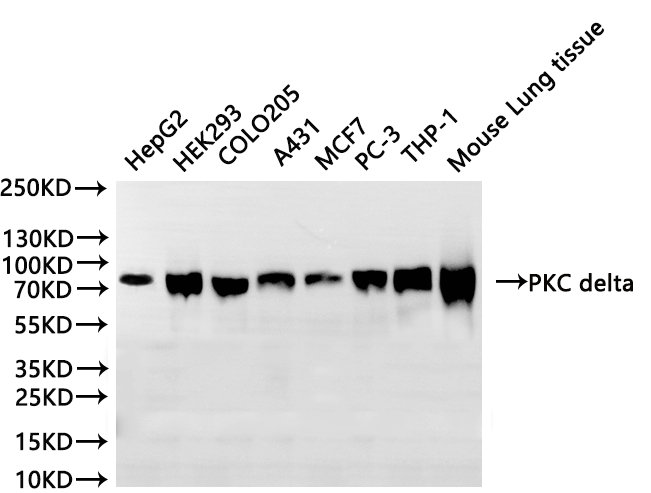
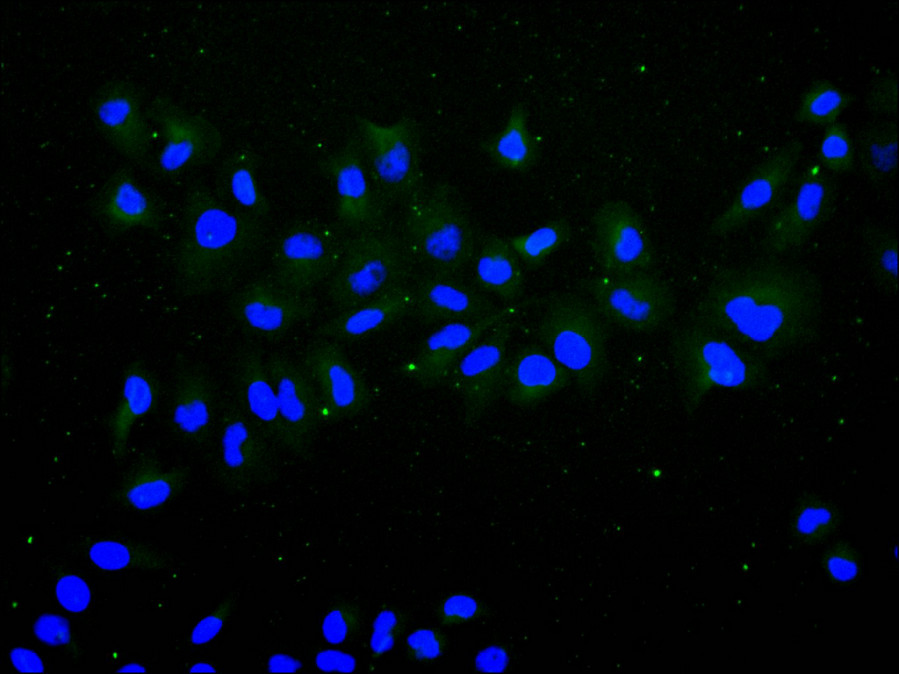
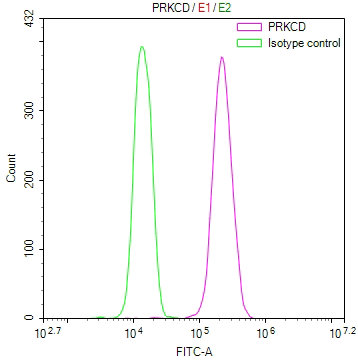
Validation data demonstrate robust performance across multiple applications. In western blotting, the antibody detects PRKCD at approximately 80 kDa, slightly above the predicted 78 kDa molecular weight, a difference attributable to post-translational modifications such as phosphorylation that are characteristic of this kinase. Detection has been confirmed in diverse human cell lines including HepG2, HEK293, COLO205, A431, MCF7, PC-3, and THP-1, as well as mouse lung tissue, providing cross-species reactivity for comparative studies. Immunofluorescence staining in HeLa cells reveals clear cytoplasmic localization, while flow cytometry analysis in A431 cells shows distinct positive signal separation from isotype controls.
Whether investigating PKC-mediated signaling in cancer models, immune cell function, or tissue-specific expression patterns, this antibody provides validated flexibility across western blotting, immunofluorescence, and flow cytometry applications.
There are currently no reviews for this product.





