
Call us
301-363-4651 (Available 9 a.m. to 5 p.m. CST from Monday to Friday)

| Code | CSB-RA023603MA1HU |
| Size | US$210 |
| Order now | |
| Image |
|
| Have Questions? | Leave a Message or Start an on-line Chat |
| Application | Recommended Dilution |
|---|---|
| FC | 1:50-1:200 |
Toll-like receptor 4 serves as a critical sentinel of the innate immune system, recognizing lipopolysaccharide from gram-negative bacteria and initiating inflammatory signaling cascades that shape both protective immunity and pathological inflammation. This pattern recognition receptor has become central to research spanning infectious disease, sepsis, atherosclerosis, and autoimmune conditions, making reliable detection tools essential for investigators working across these interconnected fields.
This recombinant monoclonal antibody against human TLR4, clone 2E10, offers the reproducibility that demanding immunological studies require. Because recombinant production ensures a sequence-defined antibody with consistent performance across lots, researchers can confidently compare results between experiments and build on previous findings without concerns about batch variation that can complicate longitudinal studies.
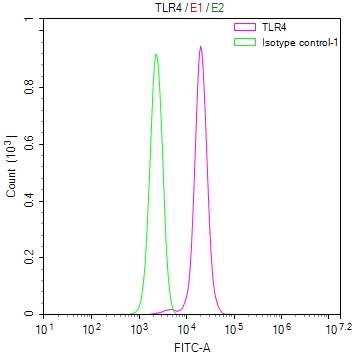
Flow cytometry validation demonstrates clear detection of TLR4 in HeLa cells, with testing performed using fixed and permeabilized cells at a 1:100 dilution. The overlay histogram shows distinct separation between the TLR4 signal and isotype control, confirming specific detection suitable for quantitative analysis of receptor expression levels. For flow cytometry applications, dilutions ranging from 1:50 to 1:200 provide flexibility to optimize signal intensity based on your specific experimental conditions and cell types.
The antibody is supplied in a glycerol-based PBS buffer optimized for long-term stability at -20°C or -80°C, supporting extended research programs. Whether investigating TLR4 signaling in cardiovascular inflammation, characterizing immune cell activation states, or studying host-pathogen interactions, this antibody provides a dependable tool for advancing understanding of innate immune recognition and its consequences in health and disease.
There are currently no reviews for this product.





