
Call us
301-363-4651 (Available 9 a.m. to 5 p.m. CST from Monday to Friday)

| Code | CSB-RA780821A0HU |
| Size | $600 |
| Order now | |
| Image |
|
| Have Questions? | Leave a Message or Start an on-line Chat |
| Application | Recommended Dilution |
|---|---|
| WB | 1:500-1:5000 |
| IHC | 1:50-1:200 |
| IP | 1:200-1:1000 |
CD19 serves as a critical B-lymphocyte surface marker that plays an essential role in B-cell development, activation, and signaling. As a co-receptor that amplifies B-cell receptor responses, CD19 has become one of the most important targets in immunology research and has gained particular prominence in the development of CAR-T cell therapies and B-cell malignancy studies.
This recombinant monoclonal antibody, generated from clone 4C7 in rabbit host, offers the consistency and reliability that demanding experimental workflows require. Because the antibody sequence is defined and produced recombinantly, researchers benefit from lot-to-lot reproducibility that eliminates the variability often encountered with traditional hybridoma-derived antibodies. This consistency proves especially valuable when establishing standardized protocols or conducting longitudinal studies.
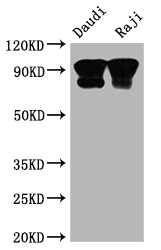
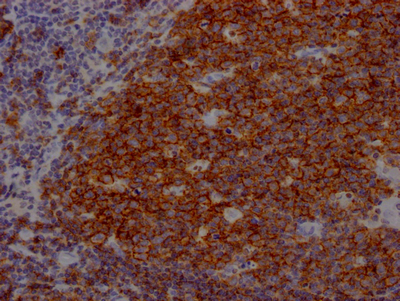
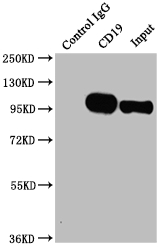
Validation across multiple applications demonstrates this antibody's versatility in the laboratory. Western blot analysis in Daudi and Raji B-lymphoblast cell lines reveals robust detection at 95 kDa, which differs from the predicted 62 kDa molecular weight. This size shift reflects the extensive glycosylation characteristic of CD19, a post-translational modification important for its biological function. Immunohistochemistry validation in human tonsil tissue confirms reliable performance in paraffin-embedded samples, while immunoprecipitation studies in Raji lysates demonstrate the antibody's capacity to capture native CD19 protein complexes for downstream analysis.
The unconjugated format provides flexibility for researchers to pair this antibody with their preferred detection systems across ELISA, western blotting, immunohistochemistry, and immunoprecipitation applications. For investigators studying B-cell biology, lymphoma characterization, or stem cell differentiation, this antibody delivers the specificity and reproducibility needed to generate publication-quality data.
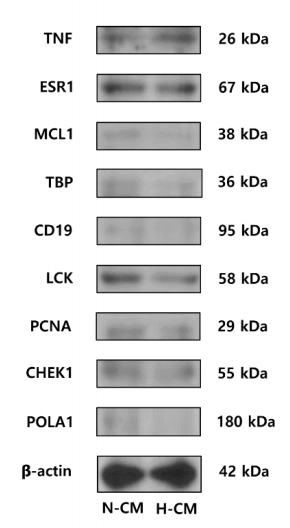
Applications : Western blot analysis
Sample type: cell
Review: The expression of hub proteins (TNF, ESR1, MCL1, TBP, CD19, LCK, PCNA, CHEK1, and POLA1) in HeLa cells treated with N-CM and H-CM. The expression of hub proteins in HeLa cells treated with N-CM and H-CM for 24 h was analyzed with Western blotting.
By Anonymous





