
Call us
301-363-4651 (Available 9 a.m. to 5 p.m. CST from Monday to Friday)

| Code | CSB-RA260334A0HU |
| Size | US$210 |
| Order now | |
| Image |
|
| Have Questions? | Leave a Message or Start an on-line Chat |
| Application | Recommended Dilution |
|---|---|
| WB | 1:500-1:2000 |
EIF4EBP1, also known as 4E-BP1, serves as a critical regulator of cap-dependent translation initiation through its interaction with eukaryotic initiation factor 4E. This phosphoprotein acts as a key downstream effector of the mTOR signaling pathway, making it an essential target for researchers investigating cellular growth control, metabolic regulation, and the molecular mechanisms underlying cancer progression. The phosphorylation status of EIF4EBP1 directly influences protein synthesis rates, positioning it at the intersection of nutrient sensing and translational control.
This recombinant monoclonal antibody, generated from clone 7F11 in rabbit host, offers the reproducibility and consistency that demanding experimental workflows require. Because recombinant antibodies are produced from defined genetic sequences rather than traditional hybridoma methods, researchers benefit from lot-to-lot uniformity that supports longitudinal studies and ensures comparable results across experiments conducted months or years apart.
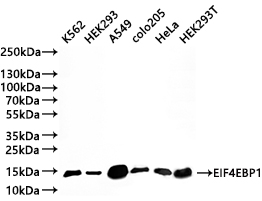
Validation testing demonstrates reliable performance in western blot applications, with successful detection confirmed across a diverse panel of human cell lines including K562, HEK293, HEK293T, A549, COLO205, and HeLa whole cell lysates. The antibody produces a clean signal at the expected 13 kDa molecular weight, matching the predicted band size and indicating specific target recognition. Recommended working dilutions range from 1:500 to 1:2000 for western blot, allowing flexibility to optimize signal intensity based on your specific sample conditions and detection system.
This antibody supports investigations into mTOR pathway dynamics, translational regulation, autophagy mechanisms, and metabolic reprogramming in cancer research, providing a dependable tool for studying one of the most functionally significant regulators of protein synthesis.
There are currently no reviews for this product.





