
Call us
301-363-4651 (Available 9 a.m. to 5 p.m. CST from Monday to Friday)

| Code | CSB-RA159493A0HU |
| Size | US$210 |
| Order now | |
| Image |
|
| Have Questions? | Leave a Message or Start an on-line Chat |
| Application | Recommended Dilution |
|---|---|
| WB | 1:500-1:5000 |
| IHC | 1:50-1:200 |
| IF | 1:50-1:200 |
| FC | 1:50-1:200 |
SMAD3 serves as a critical intracellular mediator of TGF-β signaling, functioning as a transcription factor that directly translocates to the nucleus upon pathway activation. This central role in regulating cell proliferation, differentiation, and apoptosis makes SMAD3 a key target for researchers investigating fibrosis, cancer progression, and developmental biology.
This recombinant monoclonal antibody, clone 9B2, offers the reproducibility essential for longitudinal studies and multi-site collaborations. Because the antibody sequence is defined and production occurs in controlled recombinant systems, you can expect consistent performance across lots—eliminating the variability that often complicates experiments using traditional hybridoma-derived antibodies.
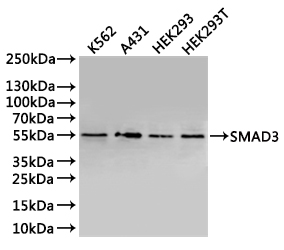
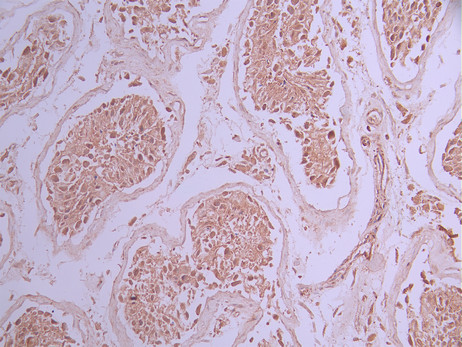
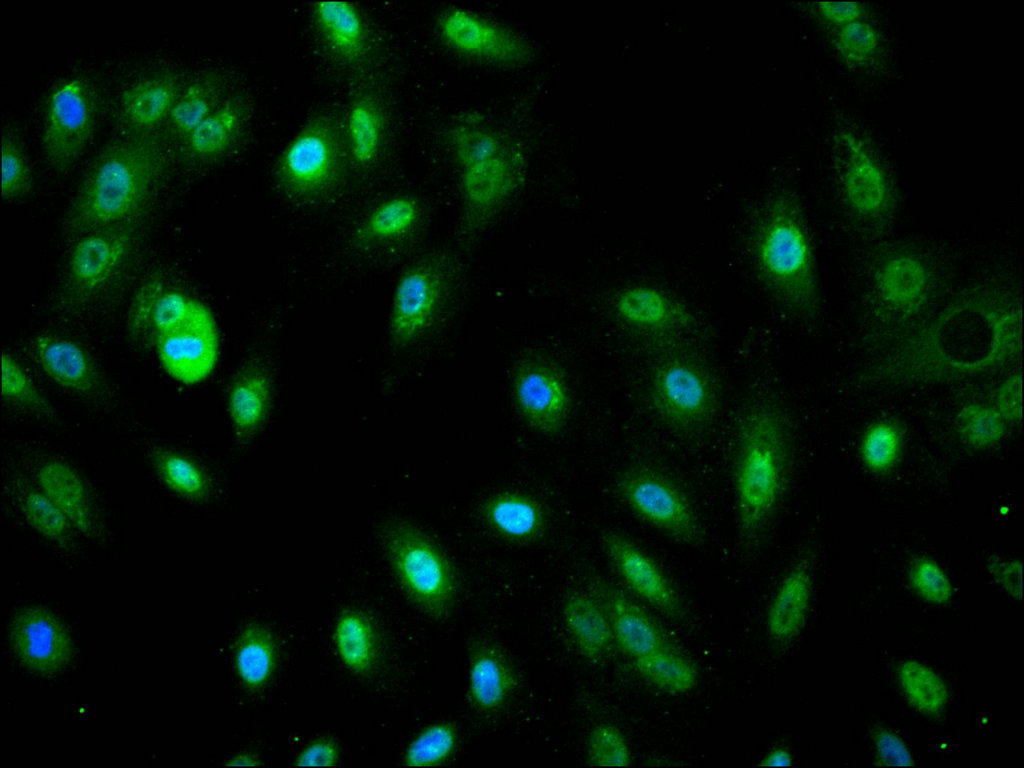
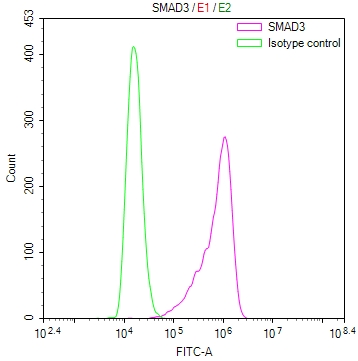
Validation across multiple detection platforms demonstrates genuine workflow flexibility. Western blot analysis confirms specific detection in K562, A431, HEK293, and HEK293T cell lysates, with the observed band at 55 kDa appearing slightly higher than the predicted 48 kDa molecular weight—a shift commonly attributed to post-translational modifications such as phosphorylation, which is particularly relevant given SMAD3's activation state-dependent function. Immunohistochemistry performed on human testis tissue sections shows clear staining with citrate buffer antigen retrieval, while immunofluorescence in A549 cells reveals the expected subcellular localization pattern. Flow cytometry validation using BxPC-3 cells demonstrates robust signal separation from isotype controls, supporting intracellular staining applications.
The antibody is supplied in a glycerol-containing buffer optimized for long-term storage stability at -20°C or -80°C. Whether you're examining TGF-β pathway dynamics in cancer models, characterizing fibrotic disease mechanisms, or studying developmental signaling, this antibody provides the technical consistency needed for reliable, publishable results.
There are currently no reviews for this product.





