
Call us
301-363-4651 (Available 9 a.m. to 5 p.m. CST from Monday to Friday)

| Code | CSB-RA007479A1068phHU |
| Size | US$210 |
| Order now | |
| Image |
|
| Have Questions? | Leave a Message or Start an on-line Chat |
| Application | Recommended Dilution |
|---|---|
| WB | 1:500-1:5000 |
Epidermal growth factor receptor phosphorylation at tyrosine 1068 represents a critical signaling event in cell proliferation, survival, and migration pathways. This autophosphorylation site serves as a major docking point for downstream effectors including Grb2 and the STAT proteins, making it an essential marker for monitoring EGFR activation status in cancer biology, drug response studies, and signal transduction research.
This recombinant monoclonal antibody, clone 1B8, offers the reproducibility that phospho-specific detection demands. Because recombinant antibodies are produced from defined genetic sequences rather than hybridoma supernatants, you can expect consistent performance across experiments and over time—particularly valuable when tracking subtle changes in phosphorylation dynamics or comparing results across extended study timelines.
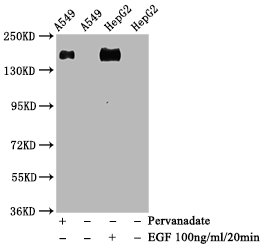
Validation in western blot applications demonstrates reliable detection of phosphorylated EGFR at the expected 175 kDa molecular weight. Testing in A549 lung carcinoma cells and HepG2 hepatocellular carcinoma cells treated with EGF or pervanadate confirms the antibody's ability to detect stimulus-induced receptor phosphorylation, providing confidence that it will perform in your activation studies. The recommended working dilution range of 1:500 to 1:5000 for western blotting allows flexibility to optimize signal intensity based on your sample's phospho-EGFR abundance.
Supplied in a glycerol-containing buffer for stability at freezer temperatures, this antibody is well-suited for researchers investigating receptor tyrosine kinase signaling, evaluating therapeutic responses to EGFR-targeted agents, or characterizing phosphorylation events in oncogenic pathways. Its specificity for the Y1068 phosphosite enables precise monitoring of this functionally significant modification in human samples.
There are currently no reviews for this product.





