


Call us
301-363-4651 (Available 9 a.m. to 5 p.m. CST from Monday to Friday)

Thank you for your continued support of CUSABIO! In the first quarter of 2026, articles related to CUSABIO products were published in excess of 800. The total number of articles has now reached 30,200.
Thank you for choosing CUSABIO research products on your scientific research journey. Your trust and support are deeply appreciated. We will continue to work hard to provide you with even better products and services.
Now, let's take a moment to share these wonderful research results.

Impact Factor: 52.7
Journal Name: Signal transduction and targeted therapy
CUSABIO Citation Product:
Mouse S100 calcium binding protein A8 (S100A8) ELISA kit; CSB-EL020641MO
Mouse Protein S100-A9(S100A9) ELISA kit; CSB-EL020642MO
This study reveals that thromboxane receptor TP in dendritic cells suppresses S100a8/a9 expression via PKCδ-Stat1 signaling, reducing neutrophil recruitment and NET formation to alleviate sepsis-induced lung injury. TP deficiency in DCs exacerbates sepsis, while DC-targeted TP agonist nanodrug improves outcomes.
Impact Factor: 20.3
Journal Name: Bioactive Materials
CUSABIO Citation Product:
GFAP Monoclonal Antibody; CSB-MA009369A0m
This study developed an injectable hydrogel (EG-gel) via co-assembly of glycyrrhizic acid and embryonic stem cell-derived small extracellular vesicles. EG-gel exhibits self-healing, shear-thinning, and tissue adhesion, prolonging sEV retention at the injury site. GA provides early anti-inflammatory effects, while sEV promotes angiogenesis and neural repair, enabling a spatiotemporal “anti-inflammatory first, repair second” strategy that significantly improves functional recovery in TBI mice.
Impact Factor: 19.1
Journal Name: Nature Cell Biology
CUSABIO Citation Product:
Human Coenzyme Q10 (CoQ10) ELISA Kit; CSB-E14081h
This study reveals that peritumoural adipose tissue secretes kynurenine, which is metabolized to 3-hydroxykynurenine in cancer cells. 3-HK directly binds NCOA4 to inhibit ferritinophagy, causing ferritin accumulation and reduced labile iron, thereby conferring ferroptosis resistance and impairing anti-PD-1 efficacy. Targeting the kynurenine pathway restores ferroptosis sensitivity and enhances immunotherapy.
Impact Factor: 15.7
Journal Name: Nature Communications
CUSABIO Citation Product:
Mouse Interleukin 6,IL-6 ELISA KIT; CSB-E04639m
Mouse Interleukin 1β,IL-1β ELISA Kit; CSB-E08054m
Mouse Tumor necrosis factor α,TNF-α ELISA KIT; CSB-E04741m
Human Soluble Cluster of Differentiation 80 (sCD80) ELISA Kit; CSB-E15768h-IS
Human p53/tumor protein,p53/TP53 ELISA Kit; CSB-E08334h-IS
Human Programmed Death Ligand-1(PD-L1/CD274) ELISA Kit; CSB-E13644h
This study identified TDRD9 upregulation in neutrophils from Pseudomonas aeruginosa pneumonia patients via RNA-seq. Mechanistically, TDRD9 suppresses neutrophil cuproptosis through the PD-L1/CD80/p38 MAPK axis, exacerbating lung injury. HA-modified siRNA nanoparticles targeting TDRD9 effectively induce neutrophil cuproptosis, reduce inflammation, and alleviate lung injury, with efficacy validated in human lung organoids, offering a promising therapeutic strategy for bacterial pneumonia.
Impact Factor: 15.7
Journal Name: Nature Communications
CUSABIO Citation Product:
Mouse anti-Mullerian hormone (AMH) ELISA kit; CSB-E13156m
Mouse Estradiol,E2 ELISA Kit; CSB-E05109m
Mouse follicle-stimulating hormone,FSH ELISA Kit; CSB-E06871m
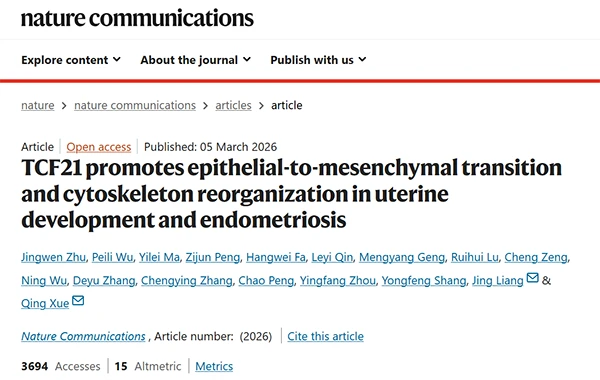
This study identifies TCF21 as a key regulator in uterine development and endometriosis. Uterine-specific Tcf21 knockout in mice causes reduced endometrial thickness, stromal cell loss, and impaired fertility. Mechanistically, TCF21 activates LIMK2-cofilin signaling to promote cytoskeleton reorganization and EMT, enhancing stromal cell invasion and adhesion. TCF21 is highly expressed in ectopic lesions, and targeting LIMK2 effectively inhibits lesion growth, offering a potential therapeutic strategy for endometriosis.
Impact Factor: 15
Journal Name: Bone Research
CUSABIO Citation Product:
Mouse follicle-stimulating hormone,FSH ELISA Kit; CSB-E06871m
Mouse luteinizing hormone (LH) ELISA kit; CSB-E12770m
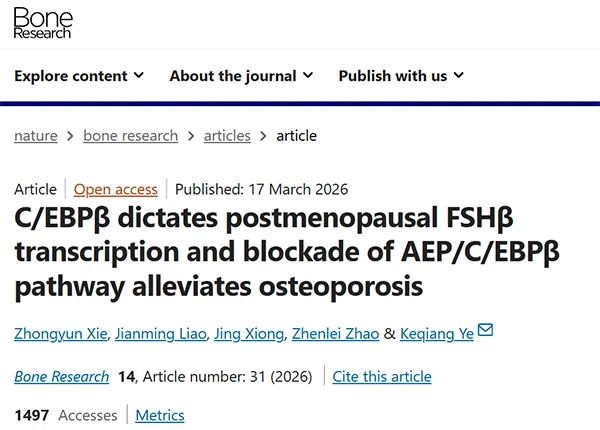
This study identifies C/EBPβ as a transcription factor of FSHβ that directly binds its promoter to regulate expression. The AEP/C/EBPβ pathway upregulates postmenopausal FSHβ levels and induces osteoporosis. Knocking out C/EBPβ or AEP, or treating with AEP inhibitor #11a, suppresses FSHβ and alleviates osteoporosis in ovariectomized mice, with #11a showing efficacy comparable to FDA-approved teriparatide. TrkB agonists also counter osteoporosis but fail to reduce FSH due to no TrkB receptors in the pituitary. It reveals the AEP/C/EBPβ pathway as a novel therapeutic target for postmenopausal osteoporosis.
Impact Factor: 14.1
Journal Name: Advanced Science
CUSABIO Citation Product:
Mouse Estradiol,E2 ELISA Kit; CSB-E05109m
Mouse Progesterone,PROG ELISA Kit; CSB-E05104m
Mouse follicle-stimulating hormone,FSH ELISA Kit; CSB-E06871m
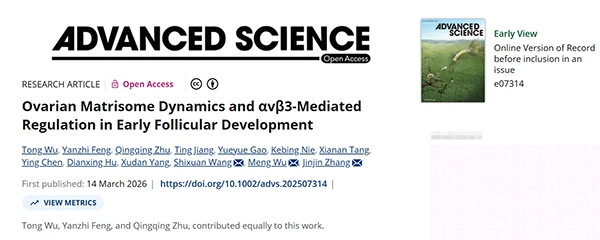
This study uses multi-omics and nanomechanics to reveal the dynamic remodeling and cross-species conservation of the ovarian matrisome during early follicular development. Integrin αvβ3 is identified as a key mediator of matrisome signals. Its inhibition has dual effects: promoting primordial follicle activation but inducing atresia, and impairing secondary follicle integrity and oocyte maturation. Similar collagen remodeling and stage-specific αvβ3 expression exist in human ovaries, providing new mechanisms and therapeutic targets for ovarian dysfunction and assisted reproductive technologies.
Impact Factor: 14.1
Journal Name: Advanced Science
CUSABIO Citation Product:
Mouse chemokine (C-X-C motif) ligand 1 (melanoma growth stimulating activity, alpha) (CXCL1) ELISA kit; CSB-E17286m
Mouse tissue inhibitors of metalloproteinase 1,TIMP-1 ELISA Kit; CSB-E08004m
Mouse matrix metalloproteinase 9/Gelatinase B,MMP-9 ELISA Kit; CSB-E08007m
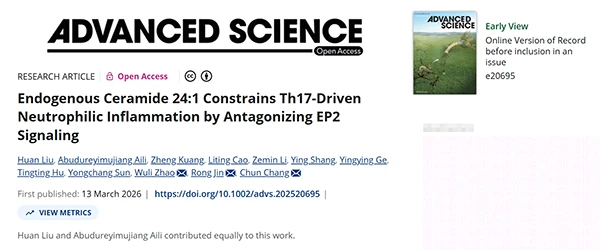
This study finds that very-long-chain ceramide Cer24:1 is significantly reduced in neutrophilic asthma (NA) patients, correlating with disease severity. Cer24:1 specifically binds EP2 receptor on CD4+T cells, inhibiting JAK2-STAT3 signaling pathway and RORγt-driven Th17 cell differentiation, thereby alleviating airway neutrophil infiltration and inflammation. Supplementing Cer24:1 mitigates symptoms in NA model mice, while PGE₂ competitively reverses its effects. These findings identify Cer24:1 as a novel metabolic regulator and provide a potential therapeutic strategy for steroid-resistant NA.
Impact Factor: 14.1
Journal Name: Advanced Science
CUSABIO Citation Product:
Mouse anti-double stranded DNA antibody (IgG) ELISA Kit; CSB-E11194m
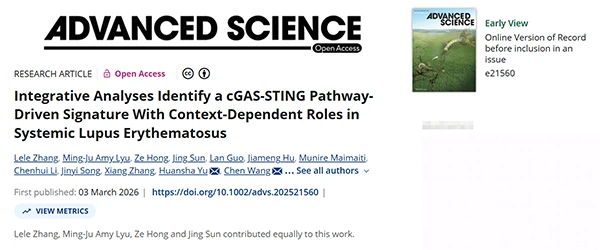
This study identifies M7core, a cGAS-STING pathway-driven gene signature, enabling quantitative assessment of pathway activity in systemic lupus erythematosus (SLE). M7core is activated in 70.4% of SLE samples, outperforms interferon-stimulated genes in diagnosis, and correlates with disease activity and lupus nephritis. STING antagonists suppress M7core and alleviate multi-organ pathology in model mice, while M7core gene ZBP1 deficiency exacerbates disease in specific models. It provides biomarkers and novel strategies for precise targeted therapy of SLE.
Impact Factor: 14.1
Journal Name: Advanced Science
CUSABIO Citation Product:
Recombinant Mouse Immunity-related GTPase family M protein 1 (Irgm1); CSB-EP730655MO

This study finds that elevated Irgm1 in neutrophils of myocardial infarction (MI) patients correlates with improved prognosis, while neutrophil-specific Irgm1 deletion exacerbates post-MI cardiac dysfunction. Mechanistically, Irgm1 interacts with PDIA3, promoting its autophagic degradation and activating the ER stress/NF-κB/caspase-3 pathway to facilitate neutrophil clearance and efferocytosis. PDIA3 inhibitor LOC14 reverses cardiac injury in Irgm1-deficient mice, identifying the Irgm1-PDIA3 axis as a novel therapeutic target and LOC14 a potential drug for MI.


